
Most sellers use the same playbook: search Alibaba, email a dozen suppliers, pick the cheapest quote, and hope for the best. That routine costs time, profit, and sleep. The top sellers on Amazon and the best DTC brands do things differently. They don’t rely on the public face of Alibaba. They use local platforms, timing, small factories, supplier relationships, and smarter shipping terms to slash costs and reduce risk.
This article lays out the exact playbook used by seven-figure sellers. I will show you the platforms they use, the timing wins, how to work with small factories, why you should sell adjacencies instead of the obvious product, how to build supplier relationships, and how to lock down DDP shipping that cuts landed cost and simplifies logistics.
Read it all. Pick one tactic and use it. Action matters more than knowing everything.
Why the Alibaba Myth Costs You Money
Alibaba is the first place new sellers go. It looks simple. Search in English, click, and contact suppliers. The problem is the price tags you see on Alibaba are not the real factory price. They are set for an international buyer. They include a foreigner markup. That markup can add 30 to 50 percent to your cost.
There is another version of Alibaba that most foreign sellers skip: 1688.com. It is the same supply chain, the same factories, the same photos, and often the same product. The difference is the price. On 1688 you find domestic Chinese pricing—often a fraction of the Alibaba list price. The trade-off is language and access. But that gap creates opportunity.
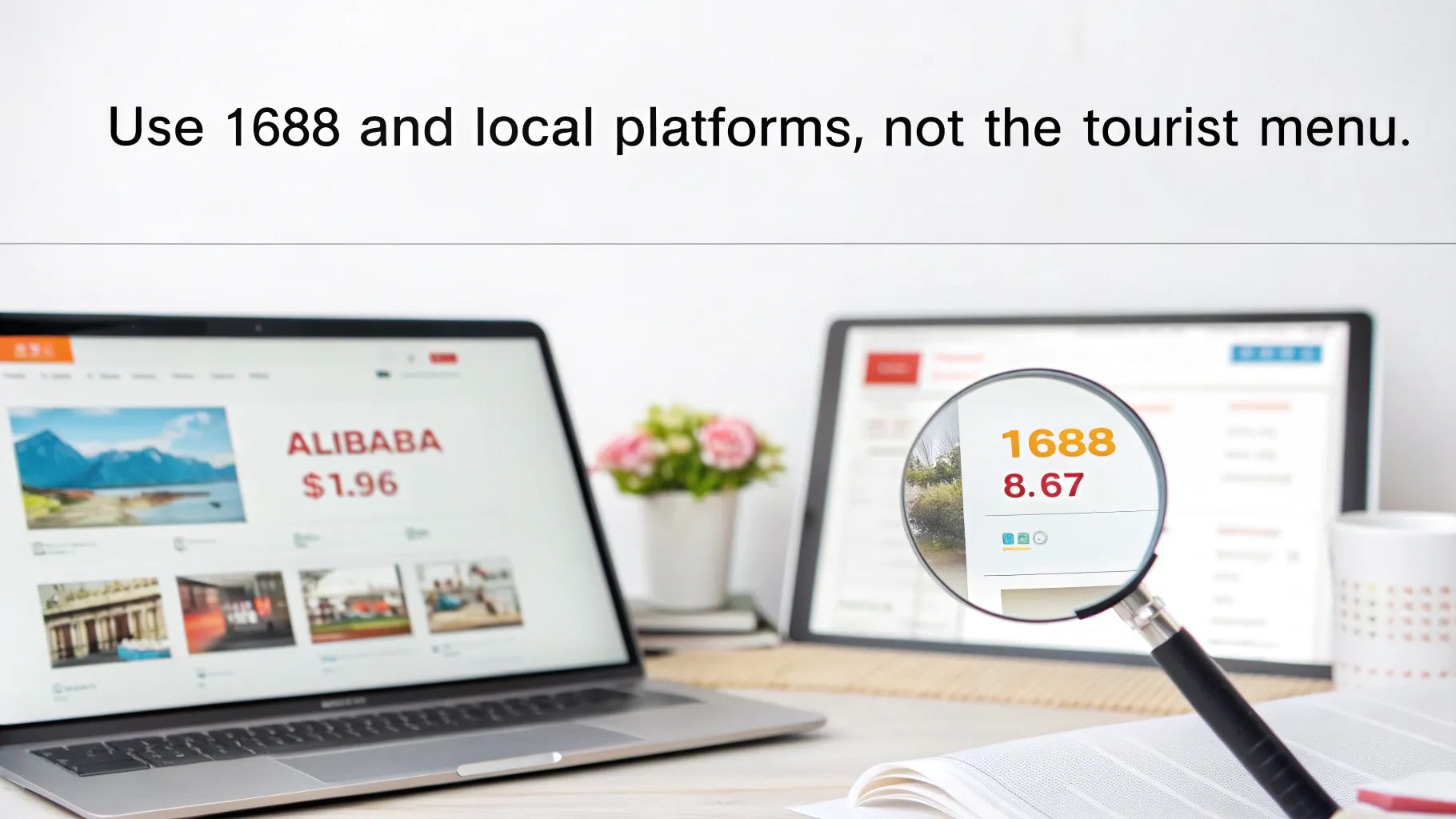
Example: A pair of slippers listed on Alibaba for $1.96 might be offered on 1688 for $0.67. You read that right. That difference kills your margins if you buy at the higher price. You lose out to sellers who know how to tap the lower price points.
What You Can Do Today: Quick Action Plan
- Stop assuming Alibaba is the only source. Learn where local suppliers list their products.
- Use translation tools to search 1688 in Mandarin, not English.
- Hire a sourcing agent who can navigate 1688 and talk to factories in Mandarin.
- Buy off-cycle for seasonal products to lock lower prices and priority slots.
- Look for small factories that will trade off lower MOQ and faster reorders.
- Sell product adjacencies rather than the headline product.
- Negotiate DDP shipping when possible to cut landed cost and headaches.
Strategy #1: Use 1688 and Local Platforms, Not the Tourist Menu
1688.com is Alibaba’s Chinese-only sister site. It targets domestic buyers. That means lower prices for the same supply. To use it you must change how you search and who you talk to.
Step-by-step: How to search 1688 for winners
- Pick the product you sell or want to sell.
- Open Google Translate and translate the product name into simplified Chinese. Keep the phrase tight—use the main keyword, not a sentence.
- Paste the Chinese keyword into 1688.com and scan the results. You will see product pages with the same factory photos and specs, but listed in local currency.
- Check for the same photos and copy to confirm it’s the same factory or the same OEM product.
- Note the price tiers for different volumes. Domestic listings often show tiered pricing clearly.
This process finds cheaper list prices. But you can’t just click buy like on Alibaba. Most sellers will need a local partner to handle negotiation, payment, samples, and inspection.
Why you need a sourcing agent
Sourcing agents live in China. They speak Mandarin. They know how factories operate. They find suppliers not listed online. They negotiate better rates and handle QC and logistics. A good sourcing agent saves you money and time.
What a sourcing agent does for you:
- Search 1688, Taobao, and local directories in Mandarin.
- Contact factories directly and schedule visits.
- Negotiate price, MOQ, tooling, and lead times.
- Order samples and run pre-shipment inspections.
- Arrange payment and documentation with vetted banks or payment channels.
How to hire and vet a sourcing agent
- Ask for references and past results.
- Check how they charge: per hour, per project, or a percentage of order value. Avoid agents who charge a large commission hidden in pricing without clear invoices.
- Ask for supplier visit reports and photos from past jobs.
- Ask for a workflow: How do they handle samples, how do they inspect products, what reports do they send?
- Start with a small paid test project, like sourcing one sample or doing one factory visit report.
Real sellers use sourcing agents like insurance. Yes, it adds cost. But you gain access to prices and suppliers you cannot reach from overseas.

Strategy #2: Buy When Others Panic, Timing Wins Matter
Most sellers source for a season when everyone else sources. That spike in demand pushes prices up and factory capacity tight. Smart sellers buy when demand is low. Factories want cash flow in slow seasons. They will offer better prices, shorter lead times, and easier terms.
How to apply timing to seasonal products
- Map your product seasonality. When will customers buy? Plan backward from the ship window and transit time.
- Buy early for peak seasons. For Christmas, buy in late winter or early spring. For summer items like pool toys, buy in winter or early spring. For Valentine’s, buy in late summer or early fall.
- Use off-season buys to lock prices and production slots. You may pay a small carry cost for longer inventory hold, but you save on unit cost and avoid stockouts.
- Use forecasts and pre-orders to test demand before large buys. Even a conservative buy in the off-season gives you pricing leverage on larger reorders later.
Example from the field: A seller bought pool accessories in March and paid $4.20 per unit. The next season the same items were available in November for $3.50 when the factory had spare capacity. That saved $0.70 per unit on a 10,000 unit order—$7,000 saved by buying off-cycle.

Strategy #3: Work with Small Factories, They Move Faster and Care More
Big factories serve big brands. They produce large volumes of the same design. That creates high MOQs, rigid terms, and less room for custom work. Small factories want your order. They will offer lower MOQs, faster turnaround, and often better willingness to customize.
Why small factories win for new sellers
- Lower MOQs let you test the market with less cash tied up.
- Faster response and production for reorders.
- More flexibility on custom packaging and small design tweaks.
- Personal service—owners and managers answer your messages directly.
Case story: Sarah, who sold kitchen tools, asked a large supplier for a quote and was told the unit price was $3.20 with a 3,000 piece MOQ. A small factory with 12 employees quoted $2.75 per unit and a 800-piece MOQ, plus free custom boxing. Sarah bought small, sold out, and re-ordered. The small factory started production immediately. The big factory put her on a six-week waitlist for reorders. Which factory was easier to scale with? The small one.
How to find small factories
- Search deeper on 1688 and Alibaba pages beyond page one. Small factories often sit on page 5 or lower.
- Ask your sourcing agent to find factories that supply larger suppliers. Those smaller shops often do subcontract or niche parts for big names.
- Visit trade shows and walk the back aisles. Small booths often hide big value.
- Look at product photos. If multiple listings use the same photos but different sellers, dig until you find the origin factory.
Risk and how to manage it
Small factories can pose risks: weaker quality control, financial instability, or lower compliance. Manage that risk:
- Require pre-production samples and a pre-production approval step.
- Use third-party inspection for first batches and major reorders.
- Split orders across two or three small factories if you fear disruption.
- Keep essential spare parts or components in safety stock.
Strategy #4: Sell Adjacency Products, Not the Headline Item
Everyone chases the headline product. Yoga mats. Air fryers. That creates intense competition and low margins. The better move is to sell the items people buy with those products. These adjacencies face less competition and often have higher margins.
Find adjacencies with bought-together data
- Look at Amazon’s Frequently Bought Together and Customers Who Bought This Item Also Bought sections.
- Use those insights to identify low-competition items that ride existing demand.
- Search for accessories, replacement parts, consumables, and add-on items.
Examples of high-opportunity adjacencies:
- Yoga: straps, carrying cases, eco-friendly sprays, extra padding, alignment guides.
- Air fryers: silicone liners, reusable parchment sheets, recipe books, cleaning tools.
- Televisions: mounts, HDMI cables, screen protectors, cleaning kits, cable management.
- Pool toys: repair kits, clips, storage bags, repair glue.
Why adjacencies work:
- Lower competition. Many private label sellers skip small adjacencies.
- Better profit per click because cost of goods is often lower and margin higher.
- Built-in demand. These products benefit from the main product’s sales curve.
How to validate adjacency ideas
- Use keyword tools to check search volume and competition for adjacency keywords.
- Check Amazon listings: number of reviews and the sales rank on similar products.
- Buy a sample and test it yourself. Look for design flaws you can fix.
- Search 1688 for adjacency items to find lower cost sources.

Strategy #5: Build Real Supplier Relationships, Not Email Chains
Sourcing is people work, not just product work. Beginners send cold emails. Pros build relationships. Long-term supplier partners give you priority production, better prices, and access to goods that never reach Alibaba.
How to build a supplier relationship
- Talk, don’t just email. Use video calls or have your agent visit.
- Pay on time and respect agreed terms. Good suppliers reward reliable clients.
- Share forecasts and honest feedback. That helps factories plan and invest.
- Visit trade shows and factories when possible. Face-to-face meetings speed trust.
Trade shows matter. At the Canton Fair or Global Sources Expo, you become a real potential customer, not just an email in an inbox. A face-to-face handshake can unlock better pricing, exclusives, and priority slots.
How to work with family-owned shops and suppliers not on Alibaba
- Ask your sourcing agent to find family-owned or local shops. They often want to try international sales.
- Offer a test order that covers tooling or small customization. This can give you an exclusive run.
- Get written agreements on price, lead time, quality standards, and re-order terms.
- Keep orders small at first and scale once the relationship and quality prove reliable.
Long-term partnerships yield the biggest wins. A supplier that knows you will often jump production queues for you when capacity tightens. They will also help solve quality issues faster.

Strategy #6: Negotiate DDP Shipping, Remove Hidden Costs and Surprises
Most sellers chase the lowest freight forwarder price. That often adds hidden fees and complexity. The elite sellers lock DDP terms. DDP means Delivery Duty Paid. The supplier handles shipping, customs, duties, and delivery to your warehouse or Amazon FBA.
Why DDP can lower your landed cost
- Factories often contract with logistics firms at volume rates. You get access to better carrier rates when you do DDP with a supplier who has those contracts.
- You pay a single landed price. No surprises from customs or unplanned fees.
- Faster processing and fewer mistakes when the supplier handles the full chain.
Example: A seller was paying $4.50 per unit plus $1.70 in separate shipping and customs for a $6.20 landed cost. After switching to DDP, the landed cost dropped to $5.00 per unit. That saved $1.20 per unit. On 5,000 units, that equaled $6,000 saved.
When DDP is not the right choice
- The supplier uses unreliable freight forwarders or cuts corners. This can leave your container in limbo.
- Your import process requires special handling that only your freight forwarder can do.
- You need to manage VAT reclaim or other tax procedures that require direct control.
How to negotiate DDP safely
- Ask the supplier for their logistics partner’s references and track record.
- Ask for a full cost breakdown: product price, packaging, inland transport, export fees, freight, insurance, import duties, and local delivery.
- Check the supplier’s experience shipping DDP to your country for similar goods and volumes.
- Request copies of prior DDP bills of lading and delivery receipts to verify credibility.
- Start with a smaller DDP order to test the process before scaling up.
When DDP works well, you save money and time. When it fails, it fails ugly. Vet suppliers’ logistics capability thoroughly.
Practical Playbook: From Idea to First Order
Below is a clear process you can use to go from product idea to first order using the strategies above.
- Idea and adjacency check
- Start with a base product or adjacency idea.
- Check Amazon’s frequently bought together and related product pages.
- Validate search volume and competition using Amazon tools.
- Find supplier options
- Search Alibaba for initial ideas and to see market prices.
- Translate into Chinese and search 1688 for lower domestic pricing.
- Ask your sourcing agent to find both large and small factories and to visit if possible.
- Request samples and compare
- Order samples from a small factory and a large factory. Note quality, packaging, and communication speed.
- Use the sample to refine your product or packaging design.
- Run a test sell on Amazon or a small ad campaign to validate demand.
- Negotiate terms
- Negotiate unit price, MOQ, lead time, and payment terms.
- Ask for DDP quotes and a breakdown of costs.
- Try to lock in price tiers for future reorders if possible.
- Place a small first order
- Keep the first order small enough to test but big enough to get meaningful pricing.
- Use a sourcing agent to manage production and inspection.
- Arrange DDP or a reliable freight forwarder if you need to manage logistics yourself.
- Inspect and ship
- Run a pre-shipment inspection or ask for factory photos and videos of production lines and packing.
- Confirm that all required compliance marks and labels are correct for your market.
- Ship and monitor logistics closely.
- Launch and collect data
- Launch your product on Amazon or your store.
- Track conversion, returns, and reviews to find quality issues early.
- Feed the data back to your supplier to improve the product for future orders.
Negotiation Scripts and Phrases You Can Use
When you have language barriers, your sourcing agent will do most of the talking. Still, it’s useful to know what to ask and how to push for better terms. Use clear, simple requests. Avoid jargon. Here are scripts your agent can use in Mandarin or you can adapt into English for suppliers who speak it.
- “We like your product. We will place a trial order of X units if you can offer Y price and Z lead time.”
- “Can you lower the price if we increase quantity to X?”
- “Please include custom packaging at this price. Can you confirm the cost?”
- “Can you send a production photo weekly during manufacture and a final photo before shipment?”
- “We need DDP to [destination city]. Can you provide a full landed cost and carrier details?”
- “If quality meets our standard, we will reorder 3 months after launch. Can we lock the price for reorders?”
Quality Control: Preventing Costly Returns
Saving money on unit price is good only if quality holds up. Low-quality goods will kill your listing with returns and bad reviews. You must control quality early and often.
Quality steps for every order
- Pre-production sample approval. Confirm fit, function, and materials.
- Pre-production photos and reports from your agent or factory.
- In-process inspections for large runs, especially on key steps like molding or assembly.
- Final random inspection before shipment: measure a sample of units for defects.
- Test certificates for electronics, safety, or regulated goods. Never skip compliance checks.
Invest in QC up front. It costs less than a wrecked product launch.

Payment Safety and Terms
Money moves create risk. Here are safe payment options and terms to consider.
- T/T (bank transfer) is common. Avoid paying the full amount up front. Pay 30% deposit and 70% on inspection.
- Use escrow or Alibaba Trade Assurance for smaller orders if you use Alibaba as a middle ground.
- For higher-risk or new suppliers, use L/C (letter of credit) or pay via a trusted sourcing agent who can escrow funds.
- Keep invoices and contracts clear with agreed quantities, specs, lead times, and penalties for missed deadlines or failed QC.
How to Scale Without Losing Margin
Scaling kills margins if you let it. Keep these points in mind as orders grow:
- Negotiate volume discounts in tiers. Lock pricing for a time window.
- Split production across two vetted suppliers to reduce risk and to preserve leverage in negotiations.
- Move some functions in-house only when you can reduce per-unit cost or improve quality measurably.
- Leverage your forecast to get price concessions. Factories love visibility.
- Keep working the logistics. Slight improvements in shipping can save big sums at scale.
Common Mistakes That Cost Sellers the Most
- Buying at peak season prices. Don’t wait until everyone else buys.
- Chasing the cheapest quote on Alibaba without vetting factories or checking 1688.
- Ignoring small factories and hidden suppliers who will offer better terms.
- Not building relationships. Suppliers treat repeat and reliable buyers better.
- Skipping pre-shipment inspections and insurance.
- Using the wrong shipping terms without vetting the logistics partner.
Checklist Before You Place Any Import Order
- Translate your product name and search 1688 to compare prices.
- Get quotes from at least one small factory and one larger supplier.
- Order samples and approve a pre-production sample.
- Ask suppliers for DDP quotes and logistics partner references.
- Confirm production lead time and inspection plans.
- Agree on payment terms and hold a deposit small enough to limit risk.
- Plan for customs, labeling, and compliance in your market.
- Run a small test sell before committing to a large order.
Case Studies: Real Savings from Real Sellers
Small wins add up. Here are short case studies that show how the strategies above change economics.
Case 1: Beginner saves $3,000 on first order
Jess from Dallas had never imported before. She used a sourcing agent to buy from 1688. Her first order saved $3,000 versus an Alibaba quote. The agent handled samples and the first inspection. Jess kept the order small, validated demand, and scaled after her first sell-out.
Case 2: Seasonal buy saves $7,000
Mike sells pool accessories. He bought in March one year and paid $4.20 per unit. The following off-season in November he locked the same product for $3.50 per unit with the same factory. The timing change saved $0.70 per unit on 10,000 units which equals $7,000.
Case 3: Trade show unlocks a seven-figure product
Tom spent $5,000 to go to the Canton Fair. He met suppliers in person, negotiated terms 40% below market, and secured three exclusive suppliers. One of the products became a seven-figure winner, yielding $1.2 million in revenue from that show investment.
Case 4: DDP cuts landed cost by $1.20 per unit
Mark paid a freight forwarder separate from the supplier. His landed cost was $6.20 per unit. The supplier offered DDP through a carrier they used and trusted. Mark’s landed cost dropped to $5.00 per unit. On 5,000 units, he saved $6,000. He also avoided customs headaches.
FAQ
Is 1688 safe to use for international buyers?
1688 lists domestic suppliers and often has lower prices. It is safe if you use the right partners. Use a vetted sourcing agent or a Chinese-speaking team member. Confirm supplier credentials, request samples, and run inspections. Start with a small test order before scaling.
Do I need to speak Chinese to buy from 1688?
No. You can use a sourcing agent or translator. Google Translate helps for searches, but negotiation, payment, and factory visits require fluent Mandarin or a local agent. Many sellers pay for an agent and still save more than the agent fee.
What does a sourcing agent charge?
Fees vary. Some charge a flat fee per project, some charge per hour, and others charge a percentage of the order (often 2-5%). Choose an agent who is transparent and provides detailed reports. Start with a small paid test to verify their work.
How do I pay suppliers safely?
Common methods include T/T with partial deposit, Alibaba Trade Assurance when used there, or escrow for first orders. For larger or long-term deals, letters of credit can work. Always get clear contracts and avoid paying the full amount up front without proof of production.
What is the difference between DDP and FOB?
FOB (Free On Board) means the seller delivers goods to the port and you handle freight, insurance, and customs. DDP (Delivery Duty Paid) means the seller handles shipping, customs, duties, and delivery to your warehouse or Amazon. DDP can simplify logistics and lower landed cost if the supplier uses good carriers.
Are small factories reliable?
They can be. Small factories may have less formal QC and more risk. But they offer lower MOQs and more flexibility. Manage risk by requiring pre-production samples, running inspections, and starting small. Keep a backup supplier when you scale.
How do I avoid tariff issues with DDP?
Tariffs depend on product HS codes and origin. Work with a customs broker and ask the supplier for accurate HS codes and material lists. A reliable DDP partner can handle tariffs correctly. For complex tariff planning, consult a trade compliance specialist.
What if I find the same product cheaper on Alibaba than my agent finds on 1688?
Check units, packaging, and shipping terms. 1688 prices are often lower, but some Alibaba suppliers will offer aggressive pricing to win new buyers. Compare full landed cost including shipping, duties, and quality checks. Always confirm which factory makes the item; pricing can vary by channel and who is reselling whom.
How small can an initial order be to test a product?
You can start with as few as a few hundred units with small factories or private runs. For some adjacencies and low-cost items, 100-300 units may be enough. The key is balancing test cost with price per unit. Smaller orders cost more per unit but limit risk.
Final Steps: What to Do Next
You now have a clear set of strategies used by top sellers. You do not need to do all of them at once. Pick one to start.
- If you want lower product prices right away: set up a 1688 search with a translator or hire a sourcing agent to do the search.
- If you sell seasonal items: map your buying calendar and move buying to off-season windows.
- If you want better terms and faster reorders: find and test small factories.
- If you want higher margins with lower competition: do adjacency research and list those products.
- If you want fewer logistics headaches: ask suppliers for DDP quotes and vet their carriers.
The winners are not the ones who know everything. They are the ones who act. Pick one strategy. Test it. Your first move does not need to be perfect. It needs to be real.
When you take one step, the next step becomes clearer. Start now.
