
Amazon still offers huge reach. It still gives small brands a shot at national scale. It can still turn a product into a business faster than almost any retail channel on earth.
But the easy era is over.
In 2026, Amazon FBA looks less like a casual side hustle and more like a strict operating system. The room for error has shrunk. The checks are tighter. The penalties arrive faster. And one small mistake in setup, labeling, or shipping can cost far more than the mistake itself should seem to justify.
That sounds grim. It is also useful to know.
If you want to build a real Amazon business now, you need to think less like a hobby seller and more like an operator. You need the right legal setup. You need clean documents. You need real barcodes. You need packaging that passes inspection the first time. You need a plan for inventory, returns, and search visibility. And if you want the best financial upside, you need to move quickly enough to unlock Amazon’s brand incentives without rushing so much that you break the rules.
This guide walks through that process from start to finish. It draws from the 2026 FBA framework described by One Xoluxion and turns it into a practical, readable playbook for anyone starting from scratch.
Before you sell one item, Amazon wants proof that you are real, traceable, and serious.
That is the point of the current onboarding process. It is not there to feel friendly. It is there to screen out bad actors, cut fraud, and protect the wider marketplace. That means every new seller enters a system built to verify first and forgive later, if at all.
For legitimate businesses, that changes the job from the start. Your first task is not product research. It is not branding. It is not ads. Your first task is to pass identity and business verification cleanly.
If you stumble here, the problem does not stay at setup. A rough start can stain account health early and lead to more review later. In a strict system, first impressions matter.
Choose the professional seller plan from day one
New sellers face an early choice:
- The individual plan, which charges 99 cents per sale
- The professional plan, which costs $39.99 per month
On paper, the cheap plan can look smart for a beginner. If you do not expect to sell 40 items in your first month, why pay the monthly fee?
Because this is not really a math question. It is a capability question.
The professional plan unlocks the actual tools needed to build a brand on Amazon. Most important, it gives you access to the Buy Box. That is the section on a product page where the Add to Cart button appears. Amazon chooses which seller appears there, and that choice drives most purchases. More than 82% of sales happen through that button.
If you are on the individual plan, your offer sits behind a much less visible “other sellers” link. Most shoppers never click it. In practice, that means low visibility and weak momentum.
The professional plan also opens up key parts of the marketplace, including:
- Eligibility for the Buy Box
- Advertising tools
- Inventory software integrations
- Access to Brand Registry
If the goal is to build a serious business, the professional plan is not an upgrade later. It is the starting point.
The identity check is strict, and small mismatches can sink it
Amazon’s 2026 verification process asks for familiar items:
- A government issued photo ID
- A chargeable credit card
- A recent bank or utility statement
That sounds routine. The hard part is how exact the review now is.
First, do not use a debit card or prepaid card. The system expects a standard credit card. In this setup, the card is not just a payment method. It is part of Amazon’s risk screen. A traditional credit card shows that a bank has already checked your identity and address. A prepaid or debit card creates more risk from Amazon’s point of view, especially if fees or claims arise later.
Second, your documents must match exactly.
This means exactly.
If your ID says “John A. Smith” and your utility bill says “John Smith,” that can trigger a rejection. If one document says “Street” and another says “St.,” that can also fail. The system reads documents through optical character recognition, not a patient human reviewer trying to infer what you meant.
Treat your legal name and address as fixed text. Use the same version, every time, on every document.
Some sellers will also face a biometric face scan or a live video call. That can feel invasive, but it reflects the scale of fraud pressure on the platform. The safest approach is simple: gather the right records, review every line, and submit only when they align.

Form a real business, not just a trading name
Physical products create physical risk. If something breaks, leaks, harms a customer, or sparks a claim, your legal structure matters.
That is why operating as a sole proprietor or under a simple DBA is risky. A DBA is only a public name. It does not shield your personal assets. If a claim hits the business, a sole proprietor may face that claim directly.
An LLC creates a line between the business and the person behind it. It is not perfect protection in every case, but it is the basic structure serious sellers should use. Pair that with an EIN from the IRS, and you have the legal shell Amazon expects to see from a real business.
At this stage, the setup checklist should look like this:
- Form an LLC
- Get an EIN
- Open a business bank account
- Use a standard credit card for the Amazon account
- Make sure all legal names and addresses match exactly across records
- Select the professional seller plan
Do not cut corners on barcodes
There was a time when sellers could buy cheap barcodes from third parties and get away with it. That time is gone.
In 2026, Amazon checks UPC ownership against the GS1 database. If the registered company tied to the barcode does not match your business, Amazon can suppress the listing and flag the account.
That means recycled or secondhand barcodes are not a clever savings move. They are a direct risk.
Buy barcodes through GS1. Use barcodes that belong to your business. Build on clean data. It costs more up front. It costs less than a listing problem later.
The big upside: Amazon is still paying brands to enter
For all the strictness, there is a strong reason sellers still enter the market. Amazon wants branded products, not just more sellers.
That is why the 2026 new seller incentives matter so much. If you build a real brand and enroll properly, the package can be worth more than $50,000 in fee cuts and credits.
The first gate is Brand Registry. To get there, you need a trademark. In the past, that could take a year and hold up a launch. The process now moves faster in one key way. Once you file the trademark application and receive a pending serial number, you can submit that in Seller Central and gain provisional access.
That change matters. It lets new brands move before the full trademark is complete.
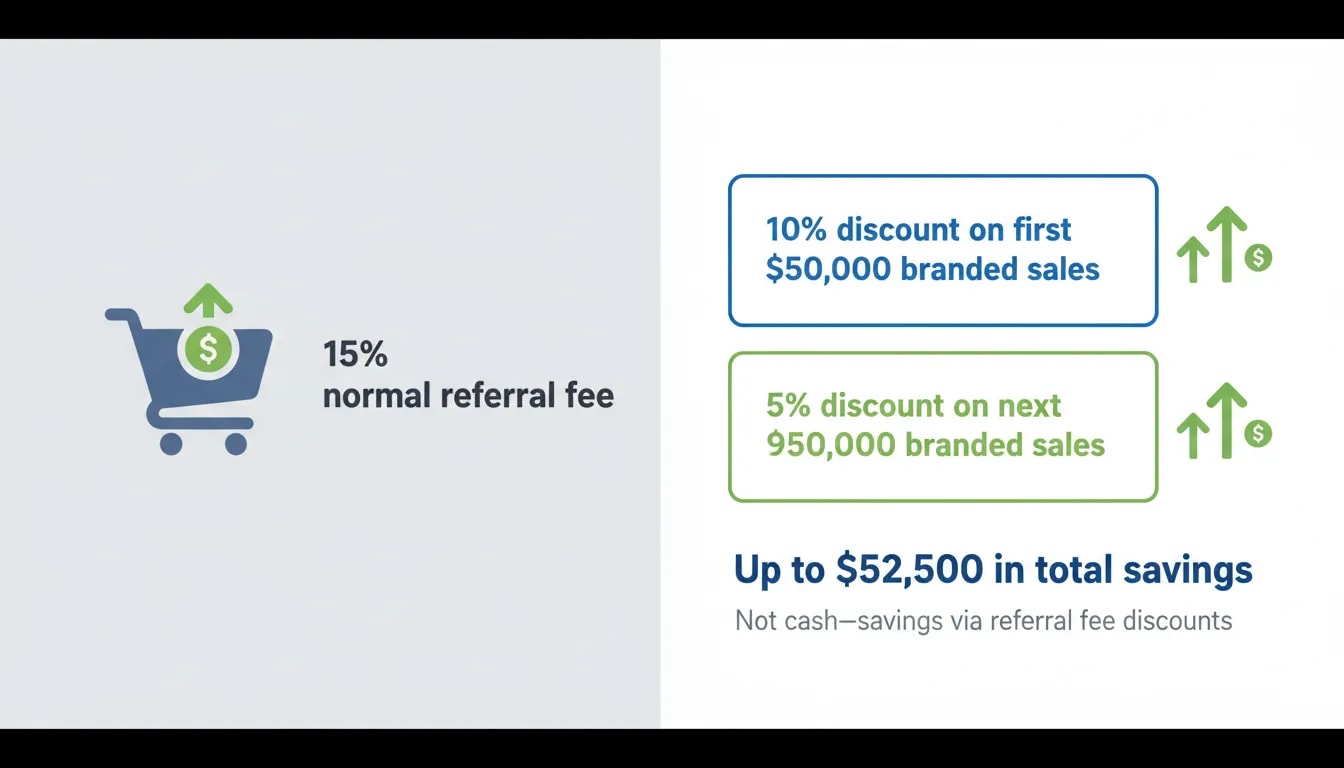
How the $52,500 brand owner bonus actually works
The headline number sounds dramatic, so it helps to be clear about what it is and what it is not.
Amazon is not handing sellers a cash deposit. The value comes through referral fee discounts.
Normally, Amazon takes a referral fee on each sale, often around 15%. Under the brand owner bonus described in the 2026 setup guide, that fee drops in two stages for eligible branded sales:
- A 10% discount on the first $50,000 in branded sales
- A 5% discount on the next $950,000 in branded sales
That creates up to $52,500 in total savings.
Here is the simple version. If you sell a $100 product and the normal referral fee is $15, the first tier can reduce that fee sharply, leaving more money in your business during the hardest phase of growth. That extra margin can fund ads, reorder stock, or simply give your cash flow room to breathe.
There are limits. You have one calendar year from the date you become eligible to use the benefit. Unused value expires. If an order gets returned, the related bonus amount goes back into your pool, which helps protect you from wasting the credit on failed sales.
On top of that, new sellers may also receive:
- $100 in credits for using an Amazon partnered carrier on the first FBA shipment
- $200 for global logistics ocean freight in some cases
- Up to $1,000 in ad credits for Sponsored Products
- $50 for digital coupons
- Fee relief through the FBA New Selection Program
That last part matters more than it may seem. The New Selection Program can shield new products from two painful fee types in the first year:
- Storage utilization surcharges
- Low inventory level fees
In short, Amazon is saying something very clear. If you bring a real brand, it will help with the launch. But only if you do the setup right.
Then comes the hard part: getting inventory into FBA without defects
This is where many new sellers get hurt.
For years, Amazon offered more slack on prep. If inventory came in messy, underlabeled, or poorly packed, Amazon could often fix it for a fee. That safety net made a lot of bad habits survivable.
In 2026, that forgiveness is largely gone.
Inventory now needs to arrive retail ready. If it does not, Amazon can charge inbound defect penalties, force costly fixes, or dispose of stock at your expense. At that point, the launch problem is no longer about convenience. It is about capital loss.
The packaging rules that now matter most
Several prep details stand out because the penalties for getting them wrong can be severe.
1. FNSKU labels must be clear and must cover old barcodes
Each item needs a scannable Amazon FNSKU label. If the manufacturer barcode remains visible and the scanner sees both codes, the item can get flagged. The problem is not cosmetic. Conveyor systems need one clean code, not two competing signals.
Use labels that fully cover any old barcode.
2. Use thermal printers, not inkjet printers
Smudged labels become unreadable labels. Inkjet labels can smear in humid conditions or during long transit. Thermal printing produces a more durable result. In a strict inbound system, that durability matters.
3. Master cartons must stay within size and weight rules
A standard master carton cannot exceed 50 pounds, and no side can run longer than 25 inches unless the product itself naturally requires larger dimensions.
Also, never tape smaller boxes together to fake one larger carton. Automated systems do not handle that well, and the result can be a damaged shipment and a compliance issue.
4. Heavy package labels are now a serious issue
This may be the most surprising rule in the whole setup process.
If a box weighs between 15 kilograms, or about 33 pounds, and 50 pounds, Amazon classifies it as a heavy package. That means it needs bright warning labels on at least five sides: top, bottom, and three side panels.
Miss one label, and the shipment can trigger defects or fines.
The rule feels harsh, but the logic is simple. Workers and robots handle these boxes at speed. Weight warnings reduce injury risk and improve handling.
5. Some packing materials are banned
Amazon’s allowed dunnage list is narrow. Air pillows, full sheets of packing paper, polyethylene foam, and standard bubble wrap are accepted. Packing peanuts, crinkle wrap, and shredded paper are not.
The issue is not taste. Loose fill materials can break apart, cling to products, and interfere with machinery.
Quality control is now an insurance policy
If a factory packs your goods overseas, you may not know about a prep error until Amazon charges you for it. That is why inspection now matters far more than it once did.
The setup guide points to third party quality checks using the ISO 2859 1 acceptable quality limit process, often called AQL. In practice, that means an inspector visits the factory before shipment, samples units and cartons at random, and checks for critical, major, and minor defects.
For Amazon prep, examples could include:
- Critical defect: a safety issue or overweight carton
- Major defect: a bad or unreadable barcode
- Minor defect: a cosmetic issue on the product or box
Paying a few hundred dollars for inspection can stop a much larger inbound penalty. If Amazon has to relabel or repackage units itself, the guide notes that fees can reach $5.72 per standard unit. On 1,000 units, that is a painful bill.
Why a 3PL now makes more sense for many sellers
At some point, every new FBA seller faces a choice. Prep inventory in house, let the supplier do it, or use a third party logistics partner.
In 2026, the case for a 3PL is stronger than ever.
In house prep gives you control, but it also demands space, tools, time, and consistent labor. It is hard to scale. It also creates more room for human error.
Supplier prep can be cheap, but it comes with risk. Not every factory understands Amazon standards. A simple misunderstanding about labels or dunnage can become your problem once the cartons hit the dock.
A 3PL sits between the factory and Amazon. The supplier ships bulk inventory to the 3PL’s warehouse. The 3PL checks the goods, applies thermal labels, confirms weights, manages carton rules, and routes the shipment into FBA. Good partners also help hold reserve stock and feed inventory into Amazon in smaller waves.
That service usually costs more per unit, often around 40 cents to $1.50. But the right way to read that cost is not “paying for stickers.” It is paying for lower error rates, better scaling, and a buffer against costly defects.
For sellers trying to build a brand rather than a one off side project, a 3PL is often not a luxury. It is part of the operating model.

The inventory game has changed too
There used to be a simple instinct in FBA: send a lot of stock and avoid going out of stock.
Now that can hurt you from both sides.
If inventory falls below about 28 days of supply, Amazon can apply a low inventory level fee. If inventory sits too long, aged inventory surcharges begin after 181 days. That is a much shorter window than many sellers once planned around.
So the task is not “send more” or “send less.” The task is to land in the middle.
The guide recommends aiming for:
- 60 to 90 days of active inventory in Amazon
- A 30 day safety buffer stored outside Amazon, often at a 3PL
Amazon’s Dynamic Capacity dashboard can help forecast needs based on sales velocity. It is not perfect, but it gives sellers a data based way to plan instead of relying on guesswork.
Placement fees now force a shipping choice
When you create an inbound shipment, Amazon may offer a choice between sending stock to one location or splitting it across several. This choice now carries real cost implications.
If you choose minimal split and send everything to one fulfillment center, Amazon may charge an inbound placement fee, often between 21 cents and $1.58 per unit, because it must move units around the network itself.
If you choose Amazon optimized split, you avoid the placement fee but may face higher freight costs because you must ship to several locations.
Neither option is always right. The right call depends on unit count, shipment size, freight rates, and your margin. The key point is this: inbound planning now needs a spreadsheet, not a shrug.
Fulfillment fees, fuel surcharges, and a packaging opportunity
Referral fees are only one part of the cost picture. Fulfillment fees matter too, and the 2026 rules add a 3.5% fuel and logistics surcharge.
But there is one area where smart packaging can win back margin: SIPP, or Ships in Product Packaging.
If your retail package is sturdy enough to ship as is, without going into an Amazon overbox, Amazon can reduce fees significantly. The guide points to savings of up to $2.04 per unit.
That is not a minor detail. It can change pricing power, ad budgets, and net profit. Brands that treat packaging as part of economics, not just design, can gain an edge here.
For more on Amazon’s broader seller framework and policies, sellers can review the official Amazon Seller Central resources.
Returns can still hurt, even when the sale looked good
Returns remain a key point of risk, especially for merchant fulfilled sellers.
Under the stricter setup described in the 2026 guide, Amazon now uses prepaid return labels more aggressively. That means if a buyer starts a return, the label cost can hit the seller account right away.
For low cost items, that can make the return itself uneconomic. In those cases, returnless refunds may be the better choice. You refund the customer and let them keep the item because paying to get it back makes less financial sense.
For high value products, the stakes are different. If a customer returns the wrong item or sends back damaged goods, the seller needs evidence. That means photos, shipping label records, and serial numbers where possible. A reimbursement claim is not casual paperwork. It needs proof.
Account health now lives or dies by the order defect rate
Amazon tracks seller performance closely, and one of the clearest measures is the order defect rate, or ODR. It includes problems such as:
- Negative feedback
- A to Z claims
- Chargebacks
The hard threshold is 1%.
That is a small number, but on a new account it takes very little to cross it. Two bad outcomes on 100 orders can put real pressure on the account. That can mean losing the Buy Box or facing suspension.
In other words, support, product quality, and shipping accuracy are not side tasks. They are part of survival.
Amazon search is now about behavior, not keyword stuffing
Listing optimization has changed too.
The older style of repeating keywords again and again is no longer enough, and in many cases it can hurt more than help. The A10 system focuses more on signals such as click through rate, conversion, and add to cart behavior. If a listing gets traffic but fails to convert, the algorithm notices.
That means strong search performance now depends on a mix of factors:
- Relevant titles and bullets
- Clear images
- Competitive pricing
- Review quality
- High conversion once shoppers land on the page
And now there is another layer.
Rufus changes how product content needs to work
Amazon’s conversational AI assistant, Rufus, shifts search from short phrases to natural questions. Instead of typing “red silicone spatula,” a shopper might ask which spatula works best at high heat and will not scratch nonstick pans.
That changes what your listing must do.
It is not enough to include broad keywords. Your content needs to contain real answers. The guide stresses the value of detailed A plus content because Rufus reads it to understand products and generate recommendations.
That means product pages should explain things clearly and directly. If material blend, heat resistance, use case, durability, or care instructions matter, say so. Structured product information is no longer just for people skimming bullets. It is also for the machine deciding whether to surface your item in the first place.
Reviews still matter, maybe more than ever
No AI system can rescue a bad product with no trust signals.
That is why the Vine program still matters for new launches. Amazon offers credits that can help sellers use Vine, where selected reviewers receive units and leave honest feedback.
The key word there is honest.
Vine is not a review hack. It is a test. If your product is weak, Vine can lock in public criticism early. If your product is good, Vine can create the first layer of proof a listing needs.
The safest rule is simple: do not enroll any product in Vine unless you have tested it yourself and trust it under real use.
The right mindset for Amazon FBA in 2026
All of this can sound intense because it is intense. There are more rules to track, more fees to model, and more ways to make an expensive mistake.
But there is another way to read the same landscape.
The system is strict, yet it is also structured. Amazon has not turned into chaos. It has turned into a checklist business. Sellers who treat it that way have a clearer shot than those chasing old shortcuts.
The real shift is in the role itself. The modern Amazon seller is no longer just sourcing products and sending boxes. The job now sits at the point where legal setup, operations, forecasting, packaging, search, and brand building meet.
That is a harder job. It is also a more durable one.
The businesses most likely to last are the ones that do four things well:
- Set up the company correctly
- Protect margin through clean operations
- Use outside partners where precision matters
- Build a brand people trust, not just a listing that ranks
A final point: in an AI market, the human side matters more
The guide closes on a point worth keeping in view. Amazon now uses AI to read listings, forecast stock, and help direct shoppers to products. Sellers use AI tools to shape content and plan inventory. In some cases, one system is preparing information for another system to read.
That is where the market is going.
But when the mechanics get more automated, the human side stands out more, not less. Product quality. Clear promise. Good packaging. Honest claims. Reliable service. A brand voice that feels like it came from a person who cared enough to get the details right.
That remains the part no fee schedule can fully automate.
Amazon FBA in 2026 is still full of opportunity. It is just no longer casual. If you want the upside, you have to earn it through precision.
FAQ
Do I need the professional seller plan if I am just starting out?
Yes, if your goal is to build a real Amazon business. The professional plan gives you access to the Buy Box, advertising tools, software integrations, and Brand Registry support. The individual plan may look cheaper at first, but it limits visibility and growth.
Can I use a debit card to open an Amazon seller account?
The 2026 setup guidance warns against it. A standard credit card is the safer choice because Amazon uses it as part of its risk review. Debit and prepaid cards can trigger account issues during onboarding.
Do my business documents really need to match exactly?
Yes. Small differences in name or address can cause automated verification failures. Use the same spelling, punctuation, abbreviations, and formatting across every document you submit.
Can I buy cheap UPC barcodes from a reseller?
That is a bad idea. Amazon checks UPC ownership against the GS1 database. If the barcode does not belong to your business, the listing can be suppressed and your account can be flagged.
Is the $52,500 seller bonus actual cash?
No. It is not a direct payout. It comes through referral fee discounts and related credits for eligible branded sellers. The value is real, but it works by lowering costs rather than sending money to your bank account.
Why are 3PLs so important for Amazon FBA in 2026?
Because Amazon’s prep standards are much stricter now. A good 3PL can check inventory, apply compliant labels, manage carton rules, hold reserve stock, and reduce the risk of inbound defect fees that can wipe out profit.
What inventory level should new sellers aim for?
The guide suggests keeping 60 to 90 days of active inventory in FBA, with another 30 days stored outside Amazon as safety stock. That helps avoid both low inventory fees and aged inventory surcharges.
How should I optimize product listings for Amazon in 2026?
Focus on conversion, not keyword stuffing. Use clear titles, strong images, useful bullets, detailed A plus content, and honest product information that answers real customer questions. That helps both the A10 system and Rufus understand and recommend your product.
Source video: Amazon FBA 2026: The Ultimate Step by Step Setup Guide by One Xoluxion.
This article was created from the video Amazon FBA 2026: The Ultimate Step-by-Step Setup Guide with the help of AI.
