
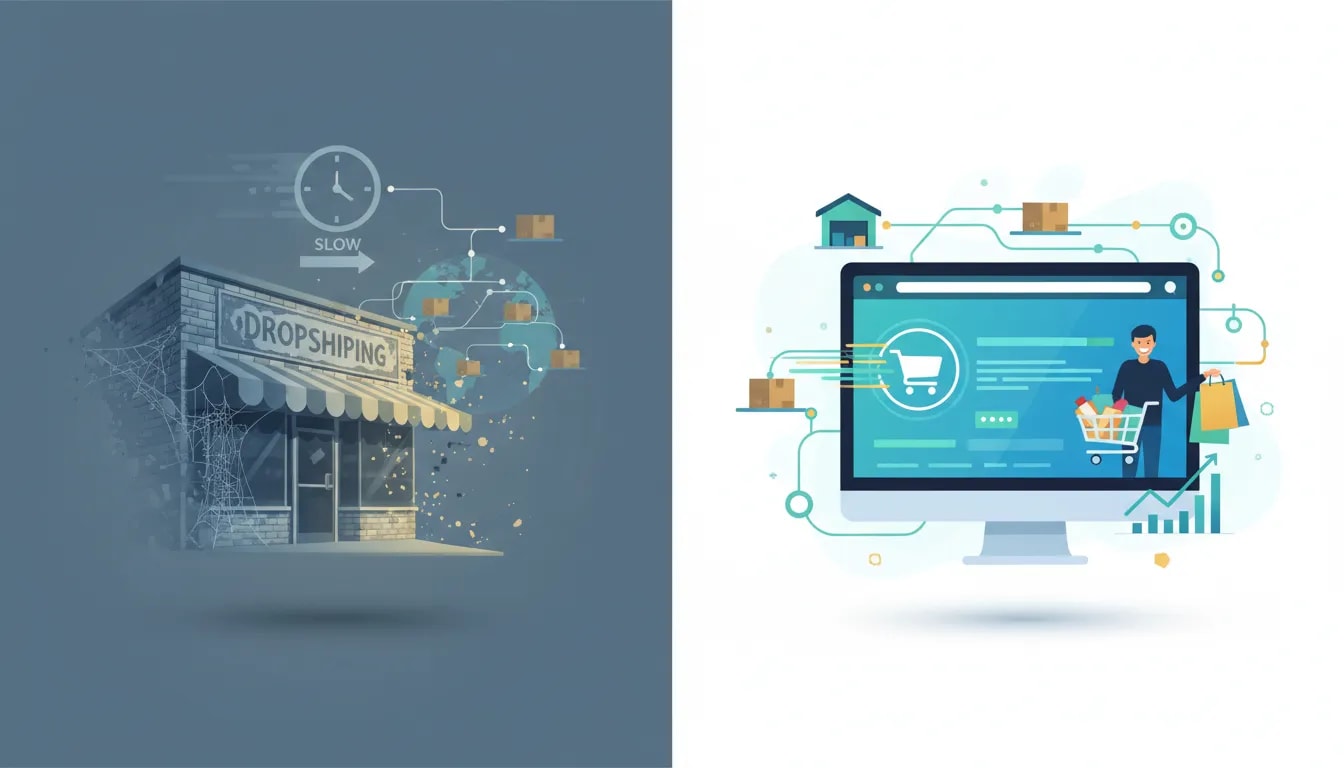
Dropshipping did not “die” in 2026. What died was a specific version of it that many stores built around one simple idea: find cheap items overseas, list them at a big markup, and let a supplier ship to the buyer while ads do the work.
That old model ran on a set of advantages that no longer hold. Imports became more expensive. Shipping got slower. Big sellers improved how they source and deliver. Customers now expect fast, consistent results. When those pieces shift, stores that rely on thin margins and long shipping times often fail.
This guide explains what changed and what a working dropshipping plan looks like now. It also includes a practical framework you can use to pivot from overseas arbitrage into a store that can build real repeat sales.
What people mean when they say “dropshipping is dead”
Search results and social posts often mix two things:
- Low risk product testing using a dropshipping supplier to validate demand.
- A full business built on arbitrage, where the store never invests in brand, packaging, or real customer retention.
In 2026, most of the “dead” talk targets the second approach. The first approach still fits a real need: you want to test product demand with limited upfront capital before you commit to inventory.
Why the old overseas arbitrage model stopped working
The shift did not come from one change. It came from several that hit at the same time. When you combine them, the profit math breaks, delivery quality drops, and customers lose trust.
1) Import rules changed and added cost
A key driver of the classic model was a trade rule that let many small shipments enter the US with no duty. That “de minimis” path got removed for certain countries and then suspended more broadly. As a result, items that used to land with low total import cost now face higher tariff rates and more customs processing.
Even small cost increases matter when your margin depends on a big markup and your ad spend gets paid up front. Some shipments also faced flat fees, which makes the impact worse on cheaper products.
2) Shipping got slower and less favorable
Another pillar was postal shipping pricing that made long distance orders feel almost as cheap as domestic ones. That advantage faded as ePacket pricing ended and the gap shrank.
Slower delivery is not just a customer service issue. It affects disputes, returns, review quality, and future conversion rates on your product pages.
3) Direct to factory sellers made price matching impossible
Competitors like large marketplaces improved on early dropshipping tactics. Instead of relying on many middle layers, they contract directly with factories, buy in big volume, ship in bulk, and sell at prices that small stores struggle to match.
When the biggest players can offer lower prices with reliable delivery, a store that only adds a markup and runs ads often cannot compete without losing money on each order.
4) Customers now expect fast delivery and stable quality
Amazon Prime trained many shoppers to expect delivery in about two days. That expectation spreads to all online shopping, including store pages that sell overseas goods.
If a buyer waits weeks, they often leave negative feedback or open disputes. Those signals can follow your product and limit your ability to scale later.
What the data says about outcomes with the old model
Many stores fail quickly. A common pattern is:
- They start with overseas sourcing and long delivery windows.
- They hope ads will cover the margin squeeze from returns and chargebacks.
- They stop before they build a brand or repeat customer base.
Some numbers shared for dropshipping outcomes highlight how uneven results can be: a large share of stores fail within a year, and only a small share reach high monthly revenue.
So is dropshipping dead in 2026?
No. Dropshipping is still useful. But you need to use it differently than the 2019 style arbitrage plan.
A good way to frame it is this:
- Dropshipping is still strong for testing. Use it to confirm which products customers actually reorder or keep.
- Brand building is how you scale profitably. Use the winning product to build a store people want to buy from again.
The new winning approach: treat dropshipping as research
Successful sellers now use a two phase method.
Phase 1: Use dropshipping to learn what sells. Not just what gets clicks.
Phase 2: Use that data to launch a real branded product offer with better delivery, packaging, and customer experience.
What “research” means in practice
When you test with dropshipping, your goal is to find proof that the product creates repeat demand and low return risk. You do not start by trying to scale the first conversion.
Instead, you look for two signals:
- Low return rate or fewer refunds and disputes.
- Repeat purchase behavior that shows buyers come back.
What “execution” means in practice
Execution focuses on turning the research winner into a branded offer:
- Use your own brand rather than a generic listing.
- Improve packaging so the unboxing matches your promise.
- Use real product photos that help customers trust the item.
- Build customer systems such as an email list and a returns process that treats buyers well.
When you do this, you reduce the dependency on pure price and pure shipping speed. You earn trust and repeat sales.
A 3 step pivot framework for dropshipping in 2026
Here is a practical framework you can copy to move from the old overseas arbitrage model to the newer approach.
Step 1: Change where the product ships from
Classic arbitrage often means shipping from overseas. That can create a gap between what customers expect and what they get.
A better plan uses a supplier setup that supports US based fulfillment. The focus is delivery time and review quality. Sellers who ship from a US warehouse infrastructure tend to see faster delivery, which helps customer satisfaction.
This step can reduce the “cheap landing price” advantage, but it helps you win the review battle that affects long term conversion.
Step 2: Test each product as a vote, not a business
This is the mindset shift that most stores miss. If you treat testing like execution, you waste money.
Use dropshipping to run a controlled test. Then measure return risk and repeat purchase.
A simple way to define the test is:
- Pick one product to test first.
- Send a few hundred orders through the supplier.
- Track which product converts and which product customers keep buying.
Do not scale the first item that makes sales. Scale the item that shows repeat behavior and low return friction.
Step 3: Turn the winner into a private label brand
Once a product proves it can earn repeat demand, you stop acting like a dropshipper that just forwards orders. You act like a brand.
In practical terms, that means private label and customer experience improvements:
- Private label the product under your own brand.
- Create custom packaging that matches the product promise.
- Use product photography that looks like your offer, not a generic catalog image.
- Set up email and returns processes that help buyers return and recommend.
When you build for repeat buyers, you reduce your dependence on new ad customers who may not stick.
Where growth comes from now: content, not just ads
In 2026, many sellers find that distribution tied to founder clarity can outperform pure ad volume. Short form video platforms can drive huge traffic, especially when the content shows the person behind the product.
The core pattern is simple:
- The creator explains what the product does.
- The creator explains why it matters.
- The creator speaks in a way that helps the right buyers self select.
That clarity supports trust and repeat purchase. Customers return when they already understand the offer and feel confident they will get what they expect.
Common mistakes that still kill dropshipping stores
Mistake 1: Scaling overseas arbitrage too fast
Some stores start spending more on ads the moment they see conversion. That can work when margins are thick and shipping is fast.
In 2026, higher import cost and slower delivery can turn a “winning ad” into a loss after returns and chargebacks.
Mistake 2: Ignoring return rate and repeat demand
Sales alone do not prove product-market fit. A product can get clicks, but still produce refunds, disputes, and low repeat behavior.
If you only optimize for initial conversion, you end up building around a product that cannot support a durable offer.
Mistake 3: Treating the store as a generic catalog
When your brand has no identity, you depend on price and shipping. But competitors with direct supply can undercut you.
Brand building creates a reason to buy from you again. It also helps customers trust what you sell.
Mistake 4: Missing the review and dispute feedback loop
Late delivery can lead to low ratings and disputes. Those outcomes can reduce your conversion rate for future visits to your product page.
Fixing fulfillment and customer expectations matters more than chasing a small price change.
How to evaluate whether your current dropshipping plan is still viable
If you already run a store, you can use this checklist to see if you are stuck in the old model.
- Where does your supplier ship from? If it is always overseas, you may fight delivery expectations.
- Are you tracking return rate and repeat purchase? If you only track initial conversions, you lack the data that predicts long term success.
- Do you build a brand? If you only change product listings and keep generic packaging, you struggle against direct competitors.
- What do reviews look like? If shipping timelines drive negative feedback, your ad spend will not fix the underlying issue.
- Are you relying on constant customer acquisition? If you do not have repeat buyers, you will keep paying to replace churn.
A practical way to run product tests like a real business owner
You can reduce wasted spend by testing like a research project.
Set clear test goals
Before you run traffic, define what “good” means for that product.
- Low returns relative to sales volume
- Repeat orders that show real demand
- Customer satisfaction that supports future conversion
Use a small number of products at a time
Testing too many items makes it hard to see which one truly wins. Pick one product, run a controlled test, then decide.
Decide quickly which products get cut
If you see weak repeat behavior or high return risk, cut early. Use the results to guide the next test.
When a product wins, plan private label immediately
Do not wait until sales slow down to start the pivot. Build your branded assets as soon as you have proof of repeat demand.
FAQ
Is dropshipping dead in 2026?
No. Dropshipping still works when it serves as low risk product testing. The old arbitrage model that relies on overseas sourcing, low import cost assumptions, and long delivery windows is the part that stopped working for many stores.
What changed that hurt traditional dropshipping stores?
Several factors shifted at once, including changes to import rules that raised landed costs, the end of certain favorable shipping advantages, tougher price competition from sellers that source directly and ship in bulk, and higher customer expectations for fast delivery and stable quality.
Should I still start a dropshipping store in 2026?
If your plan uses dropshipping to test demand, yes. If your plan depends on pure price markup on overseas items without brand building, you will likely run into margin pressure and trust issues.
What is the best way to pivot from dropshipping to a brand?
Treat dropshipping as research. Test products to find low return risk and repeat purchase behavior. Then private label the winner with custom packaging, real product photography, and customer systems like email and a solid returns process.
What should I measure during a dropshipping test?
Track return rate and repeat purchase behavior. Also monitor delivery related customer satisfaction and the signals that lead to disputes and negative reviews.
Do ads still work for dropshipping?
Ads can still drive sales, but ads alone do not fix the core problems of slow delivery, high import cost, and weak product quality signals. Ads work better when your product offer supports repeat demand and customers trust the brand.
Where can I find traffic in 2026 if not only through ads?
Short form video and social content can drive strong results when the content shows the person behind the product, explains what it does, and clearly states who it is for. Repeat buyers also help reduce dependence on constant acquisition.
Final take: the shortcut is gone, but the opportunity remains
The version of dropshipping that treated overseas arbitrage as the whole business is no longer a reliable path. Import costs rose. Shipping became less favorable. Big competitors made price matching harder. Customer expectations shifted toward speed and consistency.
Dropshipping still has value in 2026. The winners use it for what it does well: low risk demand validation. Then they build a brand around the product that proves repeat behavior.
If you want a single action plan, use this sequence: ship from a location that supports faster delivery, test products as votes by measuring returns and repeat purchases, and private label the winners with real packaging, photography, and customer systems.
