
Amazon Shop Direct is a new way for sellers to send shoppers from Amazon to their own site to finish a purchase. It sounds simple at first. You list items on Amazon. A shopper clicks. They land on your store. Amazon does not take a commission on that sale.
The catch is that Shop Direct also shifts cost, risk, and control. If you do not run the numbers, it can turn into expensive traffic with weak sales. If you plan the offer and the off Amazon experience well, it can also work as part of a wider growth plan.
This guide explains what Shop Direct is, how it changes your funnel, what to check before you use it, and a practical way to calculate whether it makes financial sense for your business.
What Amazon Shop Direct is?
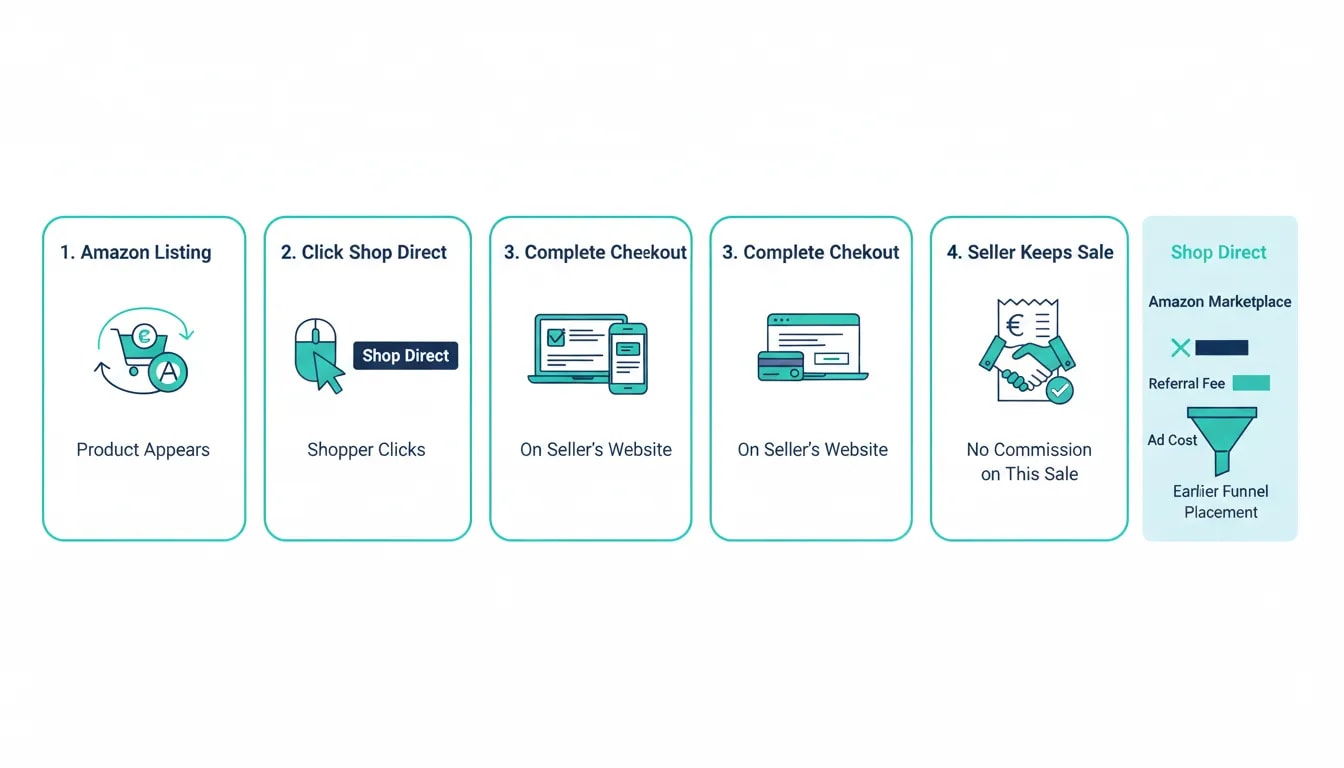
Shop Direct lets you place items on Amazon so shoppers can find them in Amazon search. When a shopper clicks, they go to your store to complete the checkout. Amazon does not take a commission on the sale because the purchase happens on your site.
From a product and storefront point of view, the flow looks like this:
- Your product listing appears on Amazon.
- A shopper clicks the Shop Direct path.
- The shopper completes checkout on your website.
- You keep the sale and the customer relationship tied to the purchase.
From a business model point of view, Shop Direct changes how you pay and how you measure success. It moves spend earlier in the journey, and it places more weight on your site conversion rate.
Why sellers got excited about it
Many sellers want the best of both worlds. Amazon brings traffic and builds in trust. Your own site can give you a better brand experience and a direct path to repeat buyers.
Shop Direct targets that goal by sending Amazon shoppers to a store you control, while removing the usual commission Amazon takes on completed sales. That is why the program feels like a win when you look at the revenue share line item alone.
But Amazon built Shop Direct as a program that fits their incentives. You should evaluate it the same way you would evaluate any paid channel. That means looking at conversion, cost per click, margin, and repeat purchase value.
How Shop Direct actually gets you sales
Shop Direct is not a “free listing boost” that automatically ranks in Amazon search. Your Shop Direct listing needs ad support to show up in search results.
That leads to two direct implications:
- You cannot assume Amazon will send you traffic. If you want visibility in Amazon search, you likely need sponsored ads.
- You must treat Shop Direct as an ad driven model. You pay for impressions and clicks before you know if the shopper will buy on your site.
What changes in your costs
On Amazon marketplace sales, sellers commonly pay a referral fee when a sale closes. In the example provided in the source material, the typical referral fee range mentioned was about 8% to 15%.
With Shop Direct, the commission on the sale disappears. But the cost does not vanish. It shifts to the front of the funnel as you buy ad placements to drive clicks from Amazon to your site.
So the question changes from “What commission will I pay?” to “What will it cost me to win a buyer on my site?”
How conversion rate math decides if Shop Direct works
Shop Direct makes a core demand of your business. Your site must convert a higher share of Amazon driven clicks than most stores do when they ask shoppers to trust a new brand experience.
The source material uses a simple example to show why the gap matters:
- An Amazon listing conversion rate of about 12%.
- A standalone site conversion rate of about 3.4%.
That gap means you need far more clicks to get the same number of sales. If clicks cost the same, your cost per sale rises sharply.
Here is the key relationship:
- Higher conversion rate means fewer clicks per sale.
- Lower conversion rate means more clicks per sale.
In practical terms, Shop Direct can work when one of these is true:
- Your off Amazon margins are high enough to cover higher paid traffic costs.
- Your off Amazon retention improves lifetime value so you recover more value over time.
The lifetime value advantage, and why it depends on your system
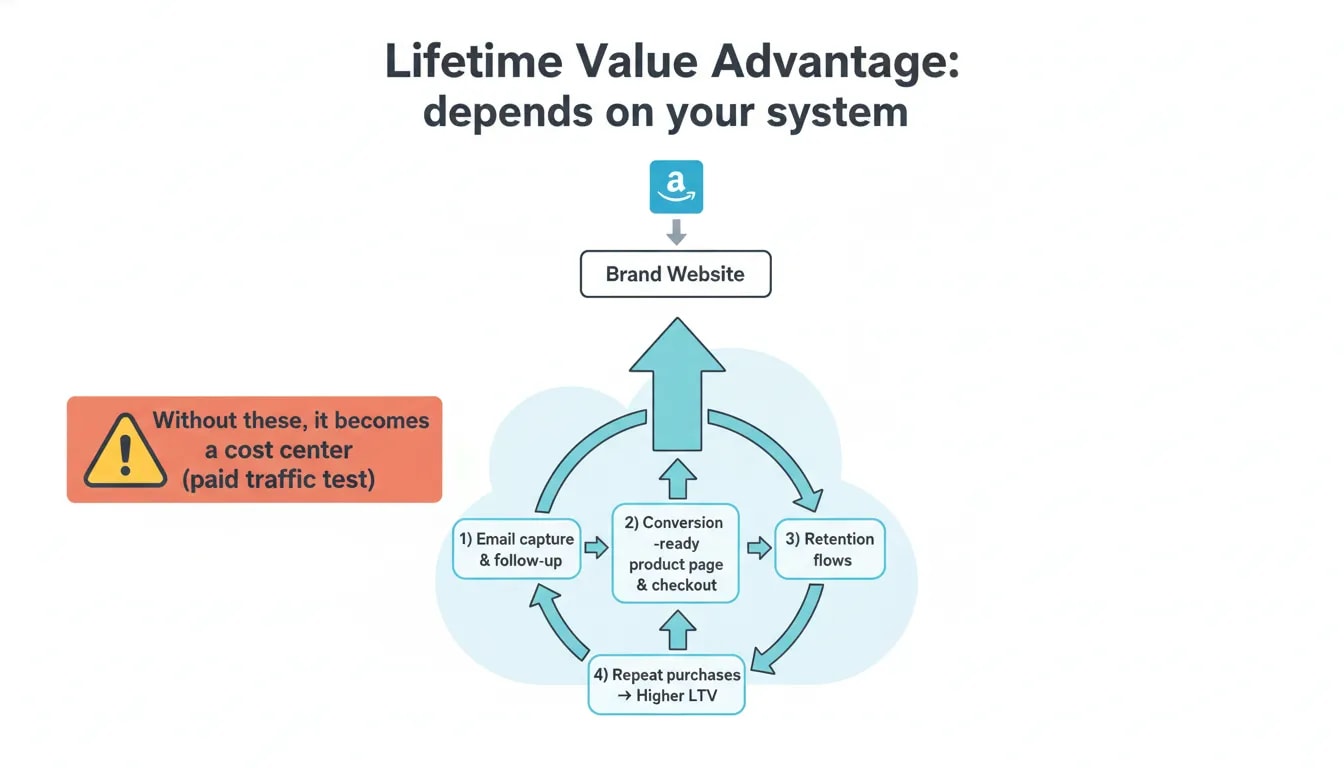
Shop Direct sends shoppers to your store, so the next stage of the relationship can happen on your terms. When a customer buys on your site, you can capture signals tied to that purchase and you can build a direct channel for later purchases.
The source material argues that this becomes powerful only if you already have infrastructure to keep shoppers coming back. That includes:
- Email capture and follow up. If you do not capture emails or contacts, you lose the chance to raise lifetime value.
- Product page and checkout experience built to convert. You must meet the shopper at the moment they decide.
- Retention flows. You need a way to bring people back without paying new acquisition costs for every purchase.
If you do not have these pieces, Shop Direct mostly becomes a paid traffic test. If your conversion rate sits low and repeat purchases do not happen, the program can become a cost center.
Data and intent: what Amazon can learn from the clicks
Because checkout happens on your site, Amazon does not see your checkout step directly. But Amazon can still see a lot about the earlier stages that drive buying intent.
The source material highlights that Amazon can learn things like:
- What search term or query led to the click.
- Which product impression the shopper saw.
- Conversion signals tied to the off site purchase outcome.
This matters for two reasons.
- It helps Amazon improve discovery and ad targeting.
- It means you should treat Shop Direct as a program inside Amazon’s broader advertising engine, not as a purely seller friendly tool.

The most common mistake: assuming “no commission” means “no real cost”
No commission can feel like a clean win. But your actual cost is the cost to get the click and the cost of sales that do not happen.
If you buy sponsored traffic and a smaller percentage of shoppers complete checkout, your cost per purchase rises even if the referral fee line item drops to zero.
Before you run Shop Direct, confirm you can answer these questions with real numbers:
- What conversion rate do you get on your site for new visitors?
- What ad cost do you face for Shop Direct clicks?
- What is your margin after all product and shipping costs at the SKU level?
- What is your realistic repeat purchase value, and do you capture it?
A practical framework to calculate whether Shop Direct makes money
To decide if Shop Direct works, use a simple unit economics model at the SKU level. You do not need a complicated spreadsheet. You need correct inputs.
Step 1: Start with your site conversion rate
Use your best estimate for a visitor who came from Amazon sponsored traffic. If you only know your overall site conversion rate, you can still use it as a starting point, but treat it as a rough figure.
Define:
- CVR = website conversion rate for these visitors (sales divided by sessions or clicks).
Step 2: Estimate your cost per click from Shop Direct
Shop Direct requires ad spend to get placement. So you need the effective cost you pay per click.
Define:
- CPC = average cost per click from your Shop Direct campaigns.
Step 3: Convert that into cost per sale
Clicks are your input. Sales are your output.
Define:
- Cost per sale from ads = CPC divided by CVR.
In formula form:
Cost per sale = CPC / CVRStep 4: Compare ad cost to margin per order
Now calculate what you keep from a purchase on your site after product, fulfillment, and shipping costs.
Define:
- Gross margin per order = your margin after product cost and fulfillment cost on that order.
- Contribution margin = margin after you include any additional costs you know you will pay per order.
Then compare:
- If Cost per sale is less than Gross margin per order, you can profit immediately.
- If Cost per sale exceeds immediate margin, the program needs lifetime value to make up the gap.
Step 5: Include lifetime value only if you capture and retain
Lifetime value can make Shop Direct work even when first purchase margin looks thin. But this only holds if you build a system that brings customers back.
Define:
- LTV = total profit per customer over time from email and repeat purchases.
- LTV contribution margin = the profit you keep after costs for repeat purchases.
Then compare ad cost plus your one time costs to LTV. If LTV is higher than your total acquisition cost, the channel can make sense even if first order margin is low.
Where Shop Direct can fit best
Shop Direct needs a reason for shoppers to buy on your site. Amazon already built trust in its own buying experience. Your site must replace that trust with a clear advantage.
The source material describes three high potential scenarios.
Use case 1: Products that need more context than Amazon can show
Some products need personalization, gift options, or a deeper story that standard listings cannot fully communicate. If the product page can explain the value quickly, Shop Direct becomes more effective.
Examples of what can create that advantage:
- Custom options and personalization steps.
- Premium packaging and unboxing experience.
- Details that help a shopper decide quickly.
Use case 2: Products where price or fees make you meaningfully better off Amazon
Price can work when it is not just “a little cheaper.” It needs to be a real reason a shopper prefers your checkout.
In the source material, the argument is that avoiding certain Amazon related costs can help brands set a better value proposition. If your offer clearly communicates that value, you can convert more clicks into purchases.
Use case 3: “Hero” items for which your brand experience closes the sale
A strong approach is to keep most of your catalog on Amazon where the buying flow already works, and move only your best fit items to Shop Direct.
This can look like:
- Use FBA or marketplace support for high velocity items that rely on Prime shipping and Amazon trust.
- Use Shop Direct for hero SKUs with higher margins, stronger differentiation, and a site experience that can outperform the marketplace listing.
Think of Amazon as discovery and your own site as the closer. If your closer cannot close, discovery spend hurts.
Where Shop Direct is most likely to fail
Shop Direct can fail when you ask Amazon traffic to trust a store that does not offer a clear upgrade.
The source material points to a few risk patterns.
Commodity products where convenience and price drive the buy
If your product competes mostly on low price and fast delivery, and your offer does not beat Amazon’s value in those terms, moving shoppers off Amazon at checkout time can reduce conversion.
Stores that do not capture customer emails or run retention
If you send traffic to your site but cannot follow up, you may never recover acquisition spend through repeat purchases. That turns the model into “pay for every order,” which can be hard to sustain.
Catalogs that do not have a strong reason to buy on your site
Even with a good ad, buyers need a reason to complete checkout off Amazon. If your product page does not sell the value fast, your conversion rate drops and cost per sale rises.
Pitfalls and practical checks before you turn it on
Here is a checklist you can use before you commit budget.
1) Validate your site conversion rate with similar traffic
If you have ever run paid traffic before, compare conversion rates for new visitors. If your site conversion sits far below your Amazon conversion, expect Shop Direct cost per sale to rise.
2) Build the product page to earn the click
Amazon traffic comes with expectations. Your page must answer purchase questions fast and remove friction. Focus on:
- Clear product benefits and proof points.
- Strong images and product options where relevant.
- Transparent shipping and returns information.
- A checkout path that does not surprise shoppers.
3) Match offers to what the shopper wants
If the reason for buying on your site is personalization, show personalization. If the reason is value, make the math obvious. Do not rely on hope.
4) Ensure you can capture and use customer data
Shop Direct can support email and retention if you set it up well. Confirm you have:
- Captures at checkout or just after purchase
- Welcome email sequences
- Post purchase flows and repeat purchase triggers
5) Run SKU level tests
Do not treat Shop Direct as one channel for your whole catalog. Test hero SKUs that you believe have strong differentiation and higher margins. Then scale only when unit economics look good.
How to decide: a quick decision guide
Use this simple decision logic.
- Go for it if your site can convert at a strong rate and you can raise lifetime value with email and retention.
- Be cautious if your conversion on your site for new visitors is much lower than Amazon conversion. In that case, only proceed if margin per order can carry the extra ad cost.
- Avoid or limit if your products are commodities and you have no clear value story off Amazon.
Shop Direct versus staying on Amazon
Shop Direct does not replace everything Amazon does well. If your advantage is Prime shipping speed and Amazon checkout trust, redirecting buyers off Amazon can reduce conversion at the worst moment.
A more balanced approach is to keep stable sellers on Amazon and use Shop Direct only where your site experience beats Amazon’s listing page.
That is why a mixed strategy often fits better than a “move the whole catalog” plan.
FAQ about Amazon Shop Direct
Does Amazon take a commission on Shop Direct sales?
Amazon does not take a commission on the Shop Direct sale because the purchase happens on your site. The program shifts costs to advertising needed to show listings in Amazon search.
Do Shop Direct listings appear organically in Amazon search?
You should not assume organic placement. The source material indicates that to appear in Amazon search results for Shop Direct, you need sponsored ad support.
What is the biggest risk with Shop Direct?
The biggest risk is that you pay for clicks and impressions before you know whether shoppers will buy on your site. If your off Amazon conversion rate is low, your cost per sale can rise sharply.
Can Shop Direct be profitable if my first order margin is low?
It can, if your lifetime value improves. That requires capturing customer data and running retention so repeat purchases bring enough profit to cover higher acquisition costs.
Which products tend to perform best with Shop Direct?
Products that need context Amazon cannot deliver well, such as personalization and premium brand experiences, and products where your off Amazon offer is clearly better on value. The source material also suggests using Shop Direct for hero items with stronger differentiation and margin.
Should I move my entire catalog to Shop Direct?
Usually no. A safer approach is to test and run Shop Direct on SKUs where your site can close the sale better, while keeping fast moving or commodity items on the marketplace flow.
Key takeaways
- Shop Direct can remove the referral commission on completed sales, but it does not remove costs. It shifts spend to ads before checkout.
- Your site conversion rate is the deciding factor. If conversion drops off Amazon, cost per sale rises.
- Lifetime value can rescue the math, but only if you capture customers and retain them with working email and repeat purchase systems.
- Shop Direct works best for differentiated hero SKUs where your site offers a clear upgrade to the purchase experience.
- Run SKU level tests and base the go or no go decision on unit economics.
Next steps: what to measure before you commit
If you plan to use Shop Direct, gather these numbers first.
- Your website conversion rate for new visitors or the closest equivalent you have.
- Your expected cost per click for Shop Direct campaigns.
- Your margin per order at the SKU level.
- Your ability to increase lifetime value with customer capture and retention.
With those inputs, you can calculate your cost per sale and decide if the model supports profit today, or profit through repeat purchases later. If you cannot measure these yet, start with the smallest test you can and improve your site and retention setup before scaling.
