

In the rapidly advancing online retail environment, it is necessary for Amazon sellers to comprehend the changing terrain of tariffs, fees, and costs. We invite you to come along with us as we explore implementable techniques focused on cost control, cash flow augmentation, and directional guidance through jungle of complexities of international marketing to be more confident. Hover text goes here…
I’m glad to have you here as I focus on developing the fee structure within the Amazon ecosystem. In this year’s edition, I’m introducing this new approach due to the positive changes in the current landscape which has turned around a lot. The topics of discussion will be practical steps and ways to address these transitions in a proficient way.
During this session, I will discuss primary topics that are the most useful for margin optimization. We will review the main amendments in the charges, analyze the strategy for margin increment, and brainstorm on the creative delivery and packing ideas. The reason we conduct such discussions is to equip you with applicable instruments that drive your profit up and make your work more efficient.
Here’s a quick overview of what to expect:
- Understanding the recent fee changes and identifying opportunities.
- Strategies to improve your margins and overall profitability.
- Innovative shipping and packaging solutions that can save costs.
- The impact of the upcoming promotions fee changes on your business.
- Best practices for managing inbound inventory and utilizing AWD effectively.

Understanding Fee Changes and Opportunities
In the process of getting through the present fee situation, one has to understand the alterations which these modifications can make on your income. Also, Amazon has decided to freeze the FBA fees during this time which is a perfect chance available for you to increase your profit.
Even though many fees have remained stable, some costs have changed, and these variations might significantly impact your work. Surround the changes that have occurred and leverage these shifts to find new, more profitable avenues.
Check the newly implemented tariff models. Such modifications could lead to unanticipated expenses that may diminish your profits if they are not handled properly. We shall talk about the ways of overcoming these tariffs and making the most of the chances they offer.
Strategies for Margin Improvement
Increasing margins is not solely dependent on slashing costs; it also requires making decisions that are tactically relevant and that also uplift the profitability of the company as a whole. There are some key strategies that you need to keep in mind:
- Optimize Product Selection: Regularly analyze your product performance to identify high-margin items. Focus on expanding your offerings in these areas.
- Streamline Operations: Evaluate your supply chain processes and eliminate inefficiencies. This could involve renegotiating contracts or switching suppliers for better rates.
- Enhance Cash Flow Management: Implement tools that allow you to track and manage your cash flow effectively. This will enable you to make informed decisions about inventory and investment.
- Leverage Data Analytics: Utilize data to gain insights into customer behavior and purchasing patterns. This can help you tailor your marketing strategies and optimize pricing.
Shipping and Packaging Innovations
Efficient shipping and packaging can have a profound effect on both your expenses and client contentment. This area of innovation has the potential to bring about more cost-effective rates and faster delivery.
The Climate Pledge Friendly program is a very interesting development. You can not only lower your shipping costs but also possibly increase your sales turnover by optimizing your packing to this initiative. Items that belong to this program frequently observe additional income because of consumer choice for eco-friendly products.
Furthermore, you could think of packing your product directly with your own packages before you ship them to the customers. This is an alternative which can cut costs by freeing up a space in your logistics setup.
Promotions Fee Changes and Their Impact
From June 2nd, Amazon will make large-scale alterations to its fee structure for promotions. The new fee system will include a flat daily fee addition to a percentage charge on sales, which may completely overturn your promotional strategies.
These modifications necessitate a fundamental alteration in promotional tactics. Some sellers might find themselves unintentionally in debt for following the outmoded plans. Rely on the new Amazon calculator to see how changes will affect your distinct promotions and adjust your approach as instructed.
As Prime Day is around the corner, it is high time to readjust your marketing plans to the new fee arrangements and still make profits.
Navigating Inbound Inventory and AWD
Acknowledge the process of dealing with inbound inventory, especially with regard to AWD (Amazon Warehouse Distribution), as one of the fundamental factors that will help you preserve profitability. Amazon is pushing sellers to implement said operations; however, it is important to first review the related expenses.
Imagine a situation where you have to think about the expenses of sending a huge load of goods to a place. If that place uses inbound placement as its first strategy, then you may end up with costs that are huge and not worth it. No matter what the situation is, assess if AWD is the best choice in your situation.
By managing your inbound inventory efficiently and being aware of the ins and outs of AWD, you can sidestep avoidable charges and keep a robust margin.
Unit Economics and Cash Flow Management
For profitability optimization, it is extremely important to have a complete understanding of unit economics. This also includes the tasks of examining the unit costs for each product, including but not limited to the landed cost, shipping, and storage fees. Thanks to these metrics, you can now locate the areas with the largest expenditures and give a clearer picture of the effect they have on your total cash flow.
A good number of sellers fail to notice the lasting influence of fees of storage. Actually, these fees can minimize your profits, especially if you keep the inventory for a really long time that has not been sold. It is a matter of life and death to keep a watchful eye on these costs to prevent them from becoming the hidden profit killers.
Instead of going for external funding, one great method to handle cash flow is to employ the cash that is already in your business. Shift your inventory plan and place a focus on high-moving products while eliminating slow-moving stock. Besides being helpful to release cash, these steps also function as a storage cost reducer.
Optimizing certain aspects of your operations can dramatically result in enhancing your profitability. For instance, a pricing strategy based on the evaluation of the unit economics can facilitate better cash flow management. Cost savings of a single dollar in the outgoings alone mean an increase in the margins.
Scaling Your Business Effectively
Scaling is not limited to just revenue creation; it requires finding the right balance between profit and cash flow. For proper scaling, the management of profit and cash flow should be your key priorities.
Initiate the process with an evaluation of your profit margins based on the different products. Point out the specific items providing the best profit margins and focus on them exclusively. Deploy a similar strategy of accompanying this effort with stringent monitoring of the cash flow. Incorporate measures that facilitate the reinvestment of the earned profits without going into deficit of the resources you have.
Data analytics is an immense power; you should make use of it. The opposite of such experience can happen when you do not know about customer behavior and sales trends that help you better plan your products and marketing. Even though you have money only for groceries, this targeted strategic approach to what and how you should sell boosts your sales and positively affects your cash flow, which besides anything else allows you to grow sustainably.
Navigating Inventory and Fees
Cost management and profit maximization becomes easy with the help of effective inventory management. Organize your delivery according to the five-box rule that is the standard for efficient shipping. According to this plan, you are entitled to send five boxes of the same SKU arrangement together without having to pay more inbound fees.
Diverse inventory sellers should promptly implement the strategic separation of shipments. In the case that you have products that do not fall under the five box rule, you will need to generate separate shipments for those. Hence, you will pay fees only for the products that require it.
Constant scrutiny of your inventory levels and modifying your purchasing strategy in accordance with the sales velocity are essential to your endeavor. The deployment of a proactive inventory management system will assist you with preventing the issue of surplus storage fees and also be beneficial for your cash flow.
Understanding Tariffs and Their Impact
The bottom line of a firm can be greatly influenced by the tariffs, particularly when sourcing is carried out from high tariff countries. A good grasp of the existing tariff landscape is absolutely necessary for profit-revenue maintenance.
The utilization of a tariff calculator for calculating the cost effect of tariffs on your products can be a very practical move. It will help you to obtain pretty close estimation of your costs and thus, make better pricing decisions simply by putting your product’s HTS code and the base duty rate.
Do not depend too much on your suppliers alone for proper tariff classifications. If your classifications are incorrect, you may incur more costs and face the risk of being audited. It would be wise to consult an expert who is into tariff classifications to help you better understand this complicated domain and be on the right side of the law.
The Importance of Professional Guidance
As the market keeps changing, professional help becomes irreplaceable. Involving professionals who deal with logistics, tariffs, and inventory can offer you the insights that will help you save a lot of money.
As a case in point, a proficient advisor can show you how to save costs in your supply chain. They can also help in finding your way through the tariff complexities, thus, ensuring that your items are classified correctly and as a result, they avoid unnecessary fees.
Acquiring professional advice is no longer a matter of abiding by the company’s rules; it’s more of a wise way to achieve growth. You will be able to make the right decisions as well as you will get direction and, as a result, your profitability will be better and your company will be apt for a long time in the market.
Strategies for Duty Drawback and Bonded Warehouses
Grasping the duty drawback mechanism can be revolutionary for your liquidity. For example, when you ship items to the U.S. but eventually export back to another country or destroy them becasue of excessive storage costs, you can repatriate almost 100% of the tariffs paid. This reverse process necessitates the correct papers and respect for the time limit before the exportation or destruction happens.
Customs professionals can make this process more engaging and easier for you. They can provide you with assistance in filling out the required forms and help you get a better understanding of the customs rules. In case you are faced with large duty costs, this approach can help you get back some money that you can use for expanding your business.
An advantage of bonded warehouses is that they are also strategic. These are the storage places that permit you to keep your goods without making immediate tariff payments. For example, you have a three-month stock, and therefore, you only pay tariffs on goods that you dispatch. This delay in payment can enhance your cash flow in a very significant way, and, as a result, you can spend your funds on other projects while still having the same inventory levels.
While considering bonded warehouses, it is advisable to work with trusted providers. Consulting a customs broker will help you comprehend the charges involved and the best practices for the effective use of these warehouses.
Amazon Reimbursement Policy Changes
The reimbursement policy of Amazon experienced major modifications on March 31st. From now on, reimbursements will only cover the cost of goods but not the additional fees such as tariffs, shipping, and inbound fees. This change indicates that, should Amazon misplace your inventory, you will not receive a refund for such extra costs.
You need to modify your accounting methods to match this new policy since it’s a must. With the actual data of the complete cost of your products, tariffs, and shipping, for correct pricing, you have to come up with proper pricing strategies. The refund alterations could impact your profit margin thus it is advisable to be ahead of time by observing your stocks and being aware of your costs.
In the process of your adaptation to the recent changes, you might want to think about creating a more sturdy guideline for warehouse management to avoid loss and enhance returns deal this way. The move will not only ensure you are in compliance with Amazon’s rules but will also be a shield to your profit.
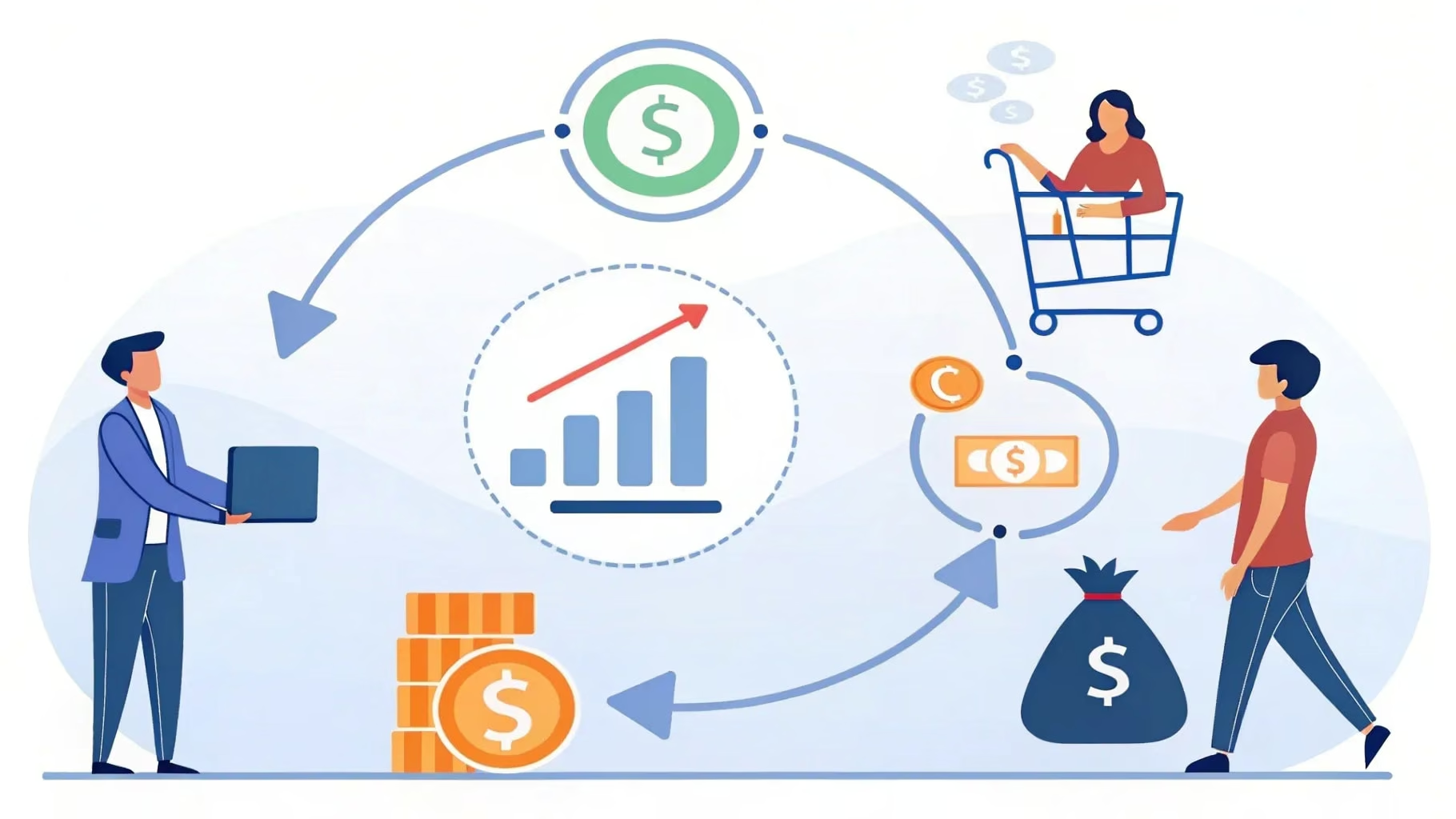
Velocity of Money and Cash Flow Management
Specifically, the velocity of money in e-commerce is a concept very critical for the sellers, because it has a direct impact on the growth and, therefore, the scale of their businesses. The term stands for how fast one can generate cash flow from the money invested. To put it plainly, it is like looking at your money moving through your business operations as though you were investing in inventory, and then getting the money from your customers at the end of the experience. The more you can sell your products quickly and the more money you can get back and put into your business, the faster you will be able to do it and the more you will be able to expand your market.
The first thing you need to do in order to speed up your velocity of money is to optimize your cash conversion cycle (CCC). This vital index illustrates the duration for your cash to flow back into the company after the sales are made. Notably, a CCC that is shorter usually means you are turning your investments more quickly, the result of which can be the multiplication of your business. In other words, by tying less time to cash in inventory or receivables, you will be able to have a larger amount of cash for future investments, operating costs, and business growth.
To find the CCC, there are two major components to be examined: days of supply and receivable days, which is the days of supply issue, that is, the average time your inventory remained unsold before a customer bought it. On the other hand, your receivable days tell you how long it usually gives you to get the money back from the customers after a sale is made. Practicing less days of supply like this by utilizing proper inventory management techniques and negotiating with suppliers about better payment terms to stretch your payable days are ways to minimize CCC drastically. Setting your sights on lowering the CCC not only boosts cash flow but also adds potential for reinvestment into the business.

Negotiating Payment Terms for Better Cash Flow
Building a good relationship with the supplier through negotiations can help reduce cash flow thereby making the business more efficient. One recommendation may be that the company should consider implementing progressive payment terms, where part of the payment is made first while the rest of the payment is deferred until a later time. Take for example, the payments being structured such that you pay thirty percent first and the rest seventy percent during the shipping time which is not only a better way for you to manage your cash flow but also gives you flexibility to handle your operations in a better way.
The strategy in question is most advantageous as it is a way of you being able to preserve cash, which in turn, allows you to allocate funds to those areas of your business that are in urgent need of money or investment. The ruse of delaying part of the payment longer is to refill the needed stocks and avoid other expense items, which is the first step toward business sustainability. Additionally, this technique is a way for you to develop a lasting bond with your suppliers who, in return, might be interested in your active communication and bargaining and, as a result, offer better rates in the future.
On top of that, it’s preferable to check out the alternatives that freight forwarders offer to possibly stretch payment terms. This will give you a chance to make a cash management strategy. Thus, you will deal with the financial problems in a more effective manner. For instance, a case where a freight forwarder grants you the opportunity to extend the payment period to the next time after the goods have been delivered to your warehouse, it might result in a very good cash flow at that particular time.
The key to having a positive cash flow, and stability in your company, is to plan your payments and make good deals. This technique will not just minimize the risk of running out of cash during the important growth periods but also allow you to finance new prospects and to grow your business while you do your other tasks more efficiently. The main point that you can see from this is that you deal with the payment delivery turns very bravely therefore you will have the currency to make an evolution in the whole financial pertinence and the operational effectiveness.
