

Short answer: yes for some sellers, no for many. In 2026 the rules that once made Amazon a one stop path to fast sales no longer hold. The platform now plays a different role in the buying journey. That change changes who can build a profitable business on Amazon and who will lose money trying.
This guide explains what changed, who should sell on Amazon now, and how to structure a launch that has a real chance of profit. If you want clear steps, unit math you can use, and a checklist to decide whether to move forward, keep reading.
Table of Contents
- Why the question matters right now
- Key concepts to understand
- Who can still make strong profit on Amazon in 2026
- Who should not sell on Amazon in 2026
- How to choose the right path: a short decision flow
- Unit economics you must model before you launch
- Three viable launch strategies for 2026
- Practical marketing channels that work to feed Amazon
- How to use Amazon without losing customer ownership
- Common mistakes that sink Amazon launches
- How to use ads smartly on Amazon
- Inventory and logistics tips for 2026
- How AI search and chat change the playbook
- Checklist to decide if you should launch on Amazon now
- Example launch timeline for a seller who already has traffic
- How to measure success early
- Common misconceptions
- When to combine Amazon and your own store
- Realistic timeline to profitability
- What to protect legally and operationally
- Final decision guide
- FAQ
- Summary and next steps
Why the question matters right now
Amazon used to drive discovery, search, and checkout in one place. That meant a strong listing plus ads often led to steady growth. Today, more shoppers find products off platform via short form social, search engines, and AI chat. Amazon is most often the place people go to finish a purchase after they already know what they want.
That shift alters the economics of selling on Amazon. If you must buy attention on Amazon to get sales, ad costs and platform fees will often erase your margin. If you control attention first, Amazon becomes a low friction place to convert that demand and benefit from storage and shipping at scale.
Key concepts to understand
- Discovery versus checkout The first step in a buyer journey is discovery. If discovery happens off Amazon, the platform acts as checkout and logistics. If discovery must happen on Amazon, you face an auction for clicks.
- Paid attention cost Amazon ad costs are higher now in many competitive categories. That raises your cost to acquire a first sale on the platform.
- Customer ownership When a sale happens on Amazon you do not get full access to the buyer. Amazon controls email and much of the customer data. On your own site you get that data and can keep the relationship.
- Infrastructure play Amazon still offers fulfillment, returns handling, and Prime trust. Those are valuable if you already have demand to move.
Who can still make strong profit on Amazon in 2026
Three seller profiles tend to work well on the platform now. If you fit one of these, Amazon can be a high leverage channel.
1. Sellers who already own traffic
If you have a following on TikTok, Instagram, YouTube, or an email list you control, you can send that audience to Amazon. You do not need to win the auction for cold traffic. You get Prime trust, fast shipping, and a simple checkout while Amazon handles fulfillment and service.
Why this works: you pay less to acquire that buyer than you would by bidding for cold Amazon clicks. Amazon becomes a high value closing tool.
2. Product testers and fast validators
If you want to quickly check product market fit without building a full store or logistics stack, Amazon lets you launch and learn fast. Use a small ad spend or partner traffic to see if people buy. If the product converts, you can scale. If it does not, you do not waste months building a site and systems.
3. Marketers who prefer to skip operations
Some founders want to focus on product and demand, not shipping returns and call center work. Amazon handles fulfillment, returns, dispute handling, and many service tasks. If you accept the fees, you can focus on growth and product design.
Who should not sell on Amazon in 2026
Not every seller should launch on the platform. The following profiles tend to lose money or waste months.
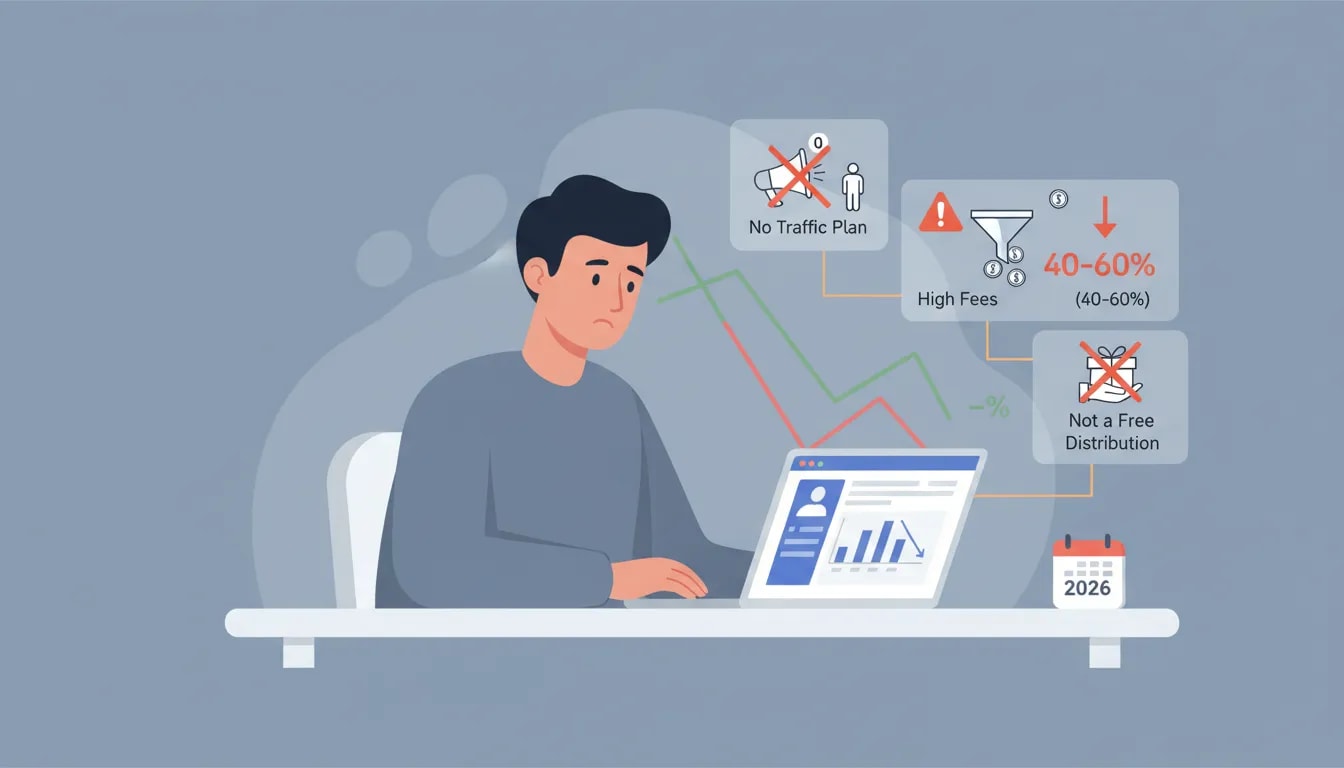
- Sellers starting from zero with no traffic plan If your plan is only to run Amazon ads and hope for organic ranking, you will likely lose money. Organic rank often requires sales velocity that you do not have yet.
- Sellers who cannot handle higher fees Depending on product size, price, and category, Amazon fees plus fulfillment can eat 40 to 60 percent of the sale price. If you need tight margins to break even you may not have room for ads or returns.
- Sellers who expect Amazon to be a free distribution machine The platform rewards products that already sell. Launching with no outside traffic is a high risk move.
How to choose the right path: a short decision flow
Answer these questions to decide whether to use Amazon now or delay launch until you build traffic.
- Do you have a way to reach buyers outside Amazon? If yes, Amazon is useful as a close and logistics tool.
- Do you need to validate demand fast? If yes, Amazon can be a low friction test bed if you accept the fees.
- Do you want full control of customer data and repeat orders? If yes, plan for your own store and list Amazon as an option.
- Are your margins large enough to buy cold traffic on Amazon and still profit? If no, build an audience first.
Unit economics you must model before you launch
Use simple math to test whether a product idea might hold up. Replace the sample numbers with your real costs before you decide.
Key inputs to collect:
- Retail price on Amazon
- Cost of goods sold per unit
- Amazon selling fees as percent of price
- Shipping and fulfillment per unit if you use Amazon fulfillment
- Average conversion rate from the traffic you will use
- Cost per click or cost per visitor for each traffic source
Sample math using conservative numbers
Assume the following for a mid priced product:
- Price 30 dollars
- Cost of goods 6 dollars
- Amazon fees 15 percent of price equals 4.50 dollars
- Fulfillment and storage 4 dollars
- Total fixed costs per unit before marketing 14.50 dollars
That leaves a gross margin of 15.50 dollars before marketing. Now test two traffic patterns.
Case A If you must buy traffic on Amazon
- Average cost per click 2.50 dollars
- Listing conversion rate 15 percent
- Cost to get one sale equals cost per click divided by conversion rate equals 2.50 divided by 0.15 about 16.67 dollars
When you add acquisition cost 16.67 dollars to fixed cost 14.50 dollars your cost per sale is about 31.17 dollars, which is higher than price 30 dollars. You lose money on each sale.
Case B You send owned traffic
- Cost per visitor from your channel 0.10 dollars via your email list or short form post that drives people at low cost
- Conversion rate on Amazon listing same 15 percent
- Acquisition cost for one sale equals 0.10 divided by 0.15 equals 0.67 dollars
Fixed cost 14.50 plus acquisition 0.67 equals 15.17 dollars cost per sale. Price 30 dollars minus cost 15.17 equals profit around 14.83 dollars per sale. That is a healthy margin.
This simple demo shows the single most important variable: where your traffic comes from. If you need to buy clicks on Amazon at current rates your math often breaks. If you control low cost traffic, Amazon can be a high value partner.
Three viable launch strategies for 2026
Below are plans you can follow depending on your starting point.
Plan 1 You already have attention
- Create or optimize an Amazon listing with clear images and short benefits first. Do not over rely on perfect A plus content before you launch.
- Enroll in Brand Registry to use enhanced content and protective tools.
- Send your audience to the Amazon listing. Use tracked links so you can see conversion data and attribute sales.
- Offer limited time coupon or deal to increase initial velocity and reviews.
- Collect off platform data such as emails via inserts, social links, or a landing page that adds value without breaking platform rules.
- Use Amazon solely for the closing and for fulfillment. Invest your ad dollars in the channels where you already have success.
Plan 2 You want to test product market fit fast
- List the product on Amazon and set a small stock level for the first test run.
- Run a controlled traffic test using your own social posts or a small creator campaign. Avoid large Amazon ad spends at first.
- Measure conversion and repeat purchase interest. If the product moves and feedback is positive, scale traffic and inventory. If not, pull back and iterate.
- Optionally replicate the same product on your own site after validation so you can capture emails and higher lifetime value.
Plan 3 You have no audience and need to build one first
- Start content first. Focus on one platform where your ideal buyer spends time. Short form video often yields the fastest reach.
- Use creators to amplify reach. Pay a small fee for posts that link to either a landing page or a prelaunch waitlist.
- Grow an email list and collect signups. Drive those emails back to a landing page with a clear offer.
- Once you have a predictable traffic source, launch on Amazon and use your list to seed early sales.
Practical marketing channels that work to feed Amazon
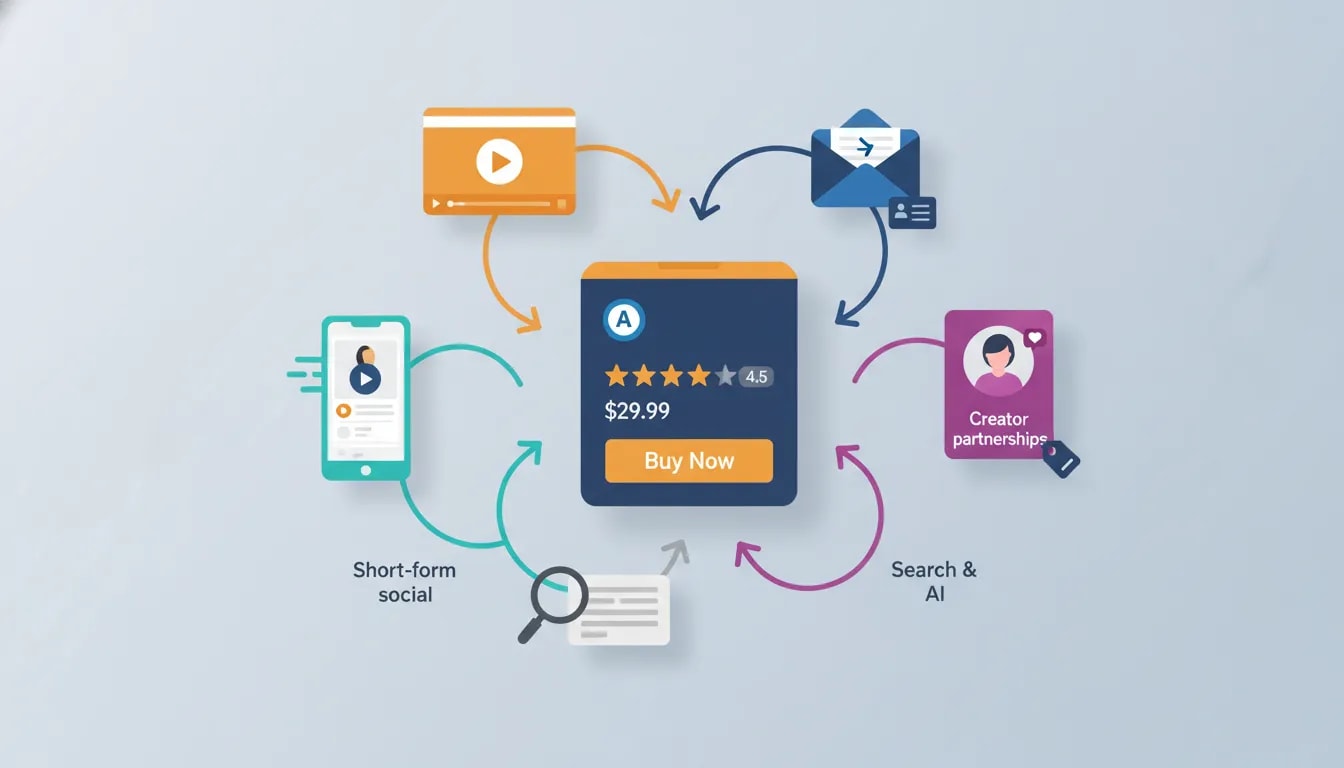
Not all traffic is equal. Choose channels that match your brand and buyer profile. Focus on one or two channels you can execute well.
- Short form social TikTok and Instagram Reels drive interest fast for consumer products. Use product demos and user content.
- Long form video and how to YouTube builds trust for complex or high price items.
- Email Email converts at low cost when you already have a list. Use it to convert launch waves and to offer bundles on your own site.
- Creator partnerships Creators provide social proof and reach. Use affiliate links, codes, or tracked links to measure impact.
- Search and AI SEO and AI answers can direct research stage buyers to your brand. Optimize content for common questions buyers ask before purchase.
How to use Amazon without losing customer ownership
Amazon keeps the buyer record. You cannot ask for buyer emails in ways that break policy. Yet there are ways to bring buyers into your ecosystem.
- Include a branded insert in the package that adds value and invites buyers to a helpful guide on your site. Do not offer incentives that try to remove the review process or violate rules.
- Use your packed box content to invite buyers to join a loyalty program or product care guide. Keep the ask about education or support rather than reviews.
- Drive social followers with QR codes on inserts. The QR can point to helpful video content or a product setup guide on your site.
- Offer bundles or subscription offers on your own site that are not available on Amazon. That gives buyers a reason to connect off platform without asking for review trades.

Common mistakes that sink Amazon launches
- Assuming organic rank will start sales Organic rank rewards sales. Without initial velocity you get little search visibility.
- Underestimating fees and returns Fees plus returns can cut deeply into margins. Model worst case return rates and adjust price or cost accordingly.
- Chasing low margin categories Heavy competition plus thin margins make it hard to buy initial customers.
- Using Amazon ads as the only traffic source High cost per click in many niches will burn cash fast during a launch.
- Neglecting creative and brand signals When people come from outside Amazon they judge your site and listing visually. Poor creative will hurt conversion even for owned traffic.
How to use ads smartly on Amazon
Ads can help, but they must fit your overall plan.
- Use Amazon ads to protect your listing and to upsell existing demand. Do not rely on them to create initial demand if you cannot afford the cost per click.
- Focus ad spend on branded keywords if you drive off platform demand. Bidding on your brand helps you keep the buy box once shoppers arrive from social or search.
- Test sponsored product campaigns with a strict CPA cap. Pause spend the moment you exceed your allowed cost per acquisition.
- Track ad spend and conversion per traffic source to see which channels make Amazon ads profitable.
Inventory and logistics tips for 2026
- Start with low stock for market tests. Excess inventory is one of the largest cash drains.
- Use FBA for reliability if you can afford the fees. FBA reduces logistics work and improves conversion via Prime.
- If using FBM in the early test, be clear on shipping times and customer service. Slow delivery can kill conversion and reviews.
- Monitor storage fees and age of stock. Convert slow SKUs into bundles or promotions to clear inventory before fees rise.

How AI search and chat change the playbook
AI search is shaping where buyers start their research. Many buyers now ask an AI for product suggestions. That means your brand needs discovery content outside Amazon if you want to capture buyers early in the journey.
Actions to take:
- Create content that answers common problem statements your product solves. AI will surface helpful, clear content in response to buyer queries.
- Structure content for snippets and short answers so it is more likely to be used by AI response engines.
- Use buyer questions and answers as topic ideas for videos and blog posts that feed into AI driven discovery.
Checklist to decide if you should launch on Amazon now
- Do you have a way to get paid or organic attention off Amazon? If yes, proceed.
- Have you modeled unit economics with conservative ad costs? If yes, proceed.
- Do you have funds set aside to test without profit for the first few weeks? If yes, proceed with caution.
- Have you planned how to capture buyer contact off platform in a rules compliant way? If yes, proceed.
- If you answered no to multiple items above, build an audience first before a big Amazon push.
Example launch timeline for a seller who already has traffic
- Week 1 Create listing, enroll in Brand Registry, produce 3 to 4 short videos and a product sheet.
- Week 2 Send first wave of owned traffic with a coupon. Monitor conversion and returns closely.
- Week 3 Adjust listing images and copy based on feedback. Use early buyers for social proof and product clips.
- Week 4 Scale traffic and add sponsored brand ads on your own terms. Add an insert that points buyers to support content on your site.
How to measure success early
Key metrics to watch in the first 30 days:
- Conversion rate from the traffic you control
- Cost per acquisition per channel
- Return rate and customer complaint rate
- Average order value and repeat purchase interest
- Unit profit after fees and ad spend
If cost per acquisition plus fees exceed price for several weeks, pause, fix the problem, and test again small scale. Fast iteration beats long slow rollouts that waste cash.
Common misconceptions
- Misconception Amazon will find buyers for any decent product. Reality Amazon favors products that already have sales velocity and external demand.
- Misconception More reviews always mean more sales. Reality Reviews help but an audience and strong conversion signals matter more for new launches.
- Misconception You can steal Amazon customers to your site easily. Reality Amazon keeps buyer contact. You must earn off platform connections through value adds and legal inserts.
When to combine Amazon and your own store
Most successful sellers use both. Each has strengths. Use your store to own the customer and drive higher lifetime value. Use Amazon to capture buyers who prefer Prime and to reduce the friction of initial purchase.
Examples of combined tactics:
- Offer exclusive bundles on your site and list the single product on Amazon.
- Use Amazon to run limited time tests while keeping your store as the home for repeat buyers.
- Run paid media to your site for long term value and to Amazon for purchase ease when buyers want Prime.
Realistic timeline to profitability
Time to profitable scale varies by business model. If you have existing traffic, you may reach break even in weeks. If you start from zero you may need six months to build an audience then another three months to test conversions on Amazon.
Plan for the long term. Many product businesses fail because founders try to get instant profit without investing in demand. If you build sustainable attention first you reduce the cost of each sale and increase your long term value.
What to protect legally and operationally
- Register your brand and trademarks. This helps with Brand Registry and reduces copycat risk.
- Document supplier terms, lead times, and quality checks. A single bad batch can destroy your early momentum.
- Read Amazon policies for inserts, packaging, and contact with buyers. Avoid actions that can suspend your listing.
- Keep safety and compliance documentation for regulated categories. Amazon will ask for it.
Final decision guide
If you already have attention and a clear offer, use Amazon as a fast path to scale while you keep ownership on your site. If you need to validate a product fast and accept upfront fees, run a small Amazon test. If you have no traffic and no plan to build it, delay launching on Amazon until you build an audience or find a partner who can bring one.
FAQ
Can I still rank on Amazon without outside traffic?
It is possible but rare. Amazon ranking favors products with sales velocity. Without external traffic most new listings struggle to get enough buys to rank in competitive categories. If you have no outside traffic consider testing a low inventory run or building an audience first.
How much do Amazon fees typically take?
Fees vary by category and size. A typical range is 40 to 60 percent of the sale price when you include referral fees, fulfillment, storage, and returns provision. Use precise estimates for your product before you launch.
Is Amazon PPC worth it for launches?
Only when you can afford the current cost per click and when ads fit your plan to acquire customers. Ads can help protect your brand when you drive external traffic. They rarely work alone as a sustainable discovery channel for new sellers without deep pockets.
Should I sell on my own site and list on Amazon at the same time?
Yes when possible. Use your site to capture emails and to offer bundles. Use Amazon to give buyers a Prime option and to reduce checkout friction. Coordinate inventory and pricing to avoid channel conflict.
How do I get buyers off Amazon without breaking rules?
Use package inserts that add value like how to guides, warranty registration, or access to a product care page. Ask buyers to join a community or to get setup help. Avoid incentives that ask for reviews or that contradict Amazon policy.
What is the best traffic source to feed Amazon?
Email lists and engaged social followings cost the least per sale. Short form social and creators drive quick interest. Paid social can work if you have strong creative and clear tracking to measure ROI.
Can small brands compete with large sellers on Amazon?
Yes, when the small brand controls its traffic or has a niche product with strong differentiation. Large sellers win on scale for paid auctions, but niche brands win when they bring their own demand and use Amazon for fulfillment.
Summary and next steps
Amazon in 2026 is not the automatic path it once was. The platform still offers massive value for the right seller. The deciding factor is attention. If you can bring buyers to Amazon, you can win. If you must buy every click on Amazon, you face high costs that eat margin.
Next step checklist:
- Do the unit economics math for your product with realistic ad costs.
- If you have no audience, pick one content channel and start building with small tests.
- If you have traffic, plan an Amazon launch that uses the platform for checkout and fulfillment while you capture off platform value.
- Track results, iterate quickly, and limit inventory until you prove product market fit.
Use this guide to make a calm data driven decision. If you follow the steps above you will know whether Amazon is a tool that helps your business or a cost that drains it.
