

Photo by Vitaly Gariev on Unsplash
Many new sellers start product sourcing with one simple rule: find the biggest factory you can, look for strong platform badges, and assume size means safety. That sounds sensible. It is not always the best move.
For many ecommerce businesses, especially small and growing ones, a smaller factory can be the better fit. A smaller supplier may offer lower minimum order quantities, faster responses, more room for custom work, and better treatment when you are not yet placing huge orders.
That does not mean small factories are always better. They bring more risk, and you need to manage that risk with care. But if you are comparing small vs large factories for sourcing, the right question is not which one looks more impressive. The real question is which one fits your order size, your timeline, and your need for flexibility.
This guide explains when small factories make sense, where large factories still win, what risks to watch for, and how to choose a supplier that supports your business instead of slowing it down.
Why this choice matters more than most new sellers think
Factory selection affects far more than unit cost. It shapes your margins, lead times, packaging options, reorder speed, and even whether your product looks different from dozens of competing listings.
Many beginners focus on one thing only: whether a supplier seems established. That is understandable. But large scale can work against you if your business is still small.
When a factory serves thousands of buyers, a small order may not get much attention. Your customization requests may move slowly. Your reorder may sit behind bigger accounts. And if the factory already makes the same item for many sellers, your product can end up looking too similar to competing offers.
A smaller factory can change that equation. If your account matters to them, they may work harder to win and keep your business.
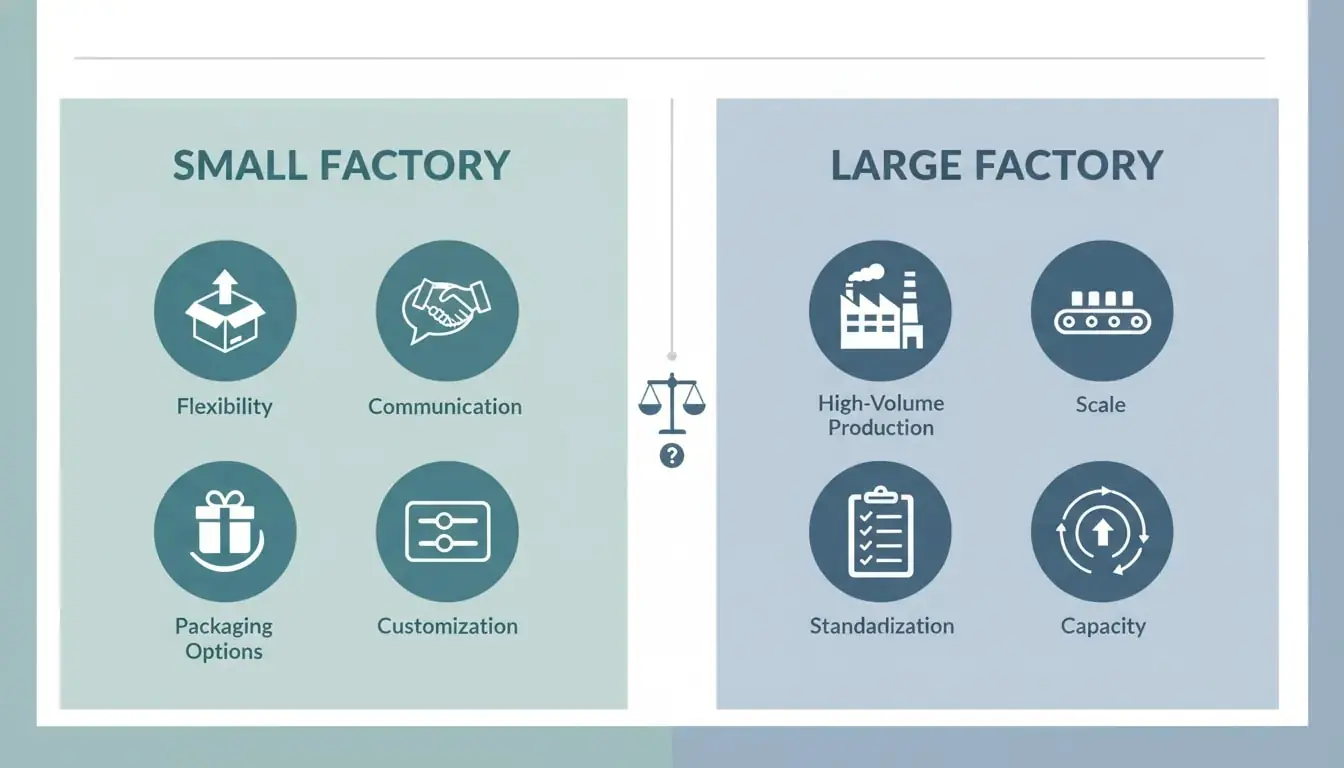
Small factories vs large factories at a glance
Here is the short version.
- Large factories often bring scale, structure, and lower risk in some areas.
- Small factories often bring flexibility, access, and better treatment for small and midsize orders.
Neither option is automatically right. The best supplier depends on your stage, product, and goals.
Small factories often work best when you need:
- Lower minimum order quantities
- More direct communication
- Faster adjustments
- Custom packaging or simple product changes
- Quicker reorders on smaller runs
- A supplier that sees your account as important
Large factories often work best when you need:
- Very high production volume
- Standardized processes
- Capacity for big repeat orders
- A supplier with broad platform history and many reviews
- Less dependence on one small team
Why small factories can be better for ecommerce sellers
The main advantage of a small factory is not just price. It is leverage. When your order matters to the supplier, you often get more flexibility across the whole relationship.
1. Lower minimum order quantities
This is often the biggest issue for newer sellers.
Large factories may set high minimums because they prefer larger clients and efficient production runs. If you are launching a new item, that can force you into more inventory risk than you want.
A smaller factory may accept a more modest order. That can help you:
- Test a product before going deep on inventory
- Protect cash flow
- Reduce storage risk
- Launch faster
If you are still validating demand, lower minimums are not just convenient. They can keep you from making a costly mistake.
2. Better pricing for smaller buyers
Many people assume big factories always offer the best price. That is not always true.
For large orders, scale may help. But for a smaller buyer, a large factory may quote a higher unit price and stick to it. You have little bargaining power, and they know it.
A smaller factory may offer a better per unit price to win your business, especially if your order is meaningful to them. They may also include things that a larger supplier treats as extra charges, such as simple packaging adjustments.
Price is not only what appears in the quote. It also includes:
- Packaging costs
- Setup costs
- Rush production costs
- Sampling costs
- The cost of high minimums
When you compare suppliers, compare the full landed and operational cost, not just the headline unit price.
3. More attention to your account
This point is easy to miss until you live through it.
Large factories often have many customers and many layers between you and production. If your order is small, your account may not get priority. That can show up in slow replies, rigid terms, and little urgency when problems arise.
With a smaller factory, your business can matter more. That can lead to:
- Quicker answers
- Faster decisions
- More willingness to solve problems
- Greater urgency on reorders
This matters most when something goes wrong, because something always does at some point in sourcing.
4. Faster reorders for growing brands
A common pain point in ecommerce is selling out and then waiting too long for the next batch.
Large factories may already have full production schedules. If they have bigger customers ahead of you, your reorder may move slowly.
A smaller factory may be able to start sooner, especially if they want to keep your business and have available capacity. That can be a major advantage when demand is moving faster than expected.
For fast moving sellers, speed can matter more than shaving a few cents off each unit.
5. More room for customization
Large factories often produce the same product for many sellers. That makes operations efficient, but it can also lead to product sameness.
If you search online marketplaces and find the same item listed over and over, this is often part of the reason. Large suppliers may prefer standard runs and limited changes.
Smaller factories may be more open to:
- Custom packaging
- Small design tweaks
- Different bundles
- Minor feature changes
- Special insert cards or labeling
That flexibility can help you avoid a product listing that looks like everyone else’s.
Where large factories still have an edge
It would be a mistake to act as if small factories always win. In some cases, large factories are clearly the better choice.
1. Higher capacity
If your business already needs large and steady volume, capacity matters. A small factory may handle your launch well but struggle once your orders rise.
Ask a simple question: if sales double or triple, can this supplier keep up?
Large factories usually have a stronger answer.
2. More visible track record
Bigger suppliers often have longer platform histories, more reviews, and a larger paper trail. That does not guarantee quality, but it gives you more signals to evaluate.
For some buyers, that added visibility reduces uncertainty.
3. More established systems
Larger operations may have tighter internal processes for production planning, documentation, and account handling. That can help if you need consistency at scale.
A small factory may be flexible, but sometimes that same flexibility means less formal structure.
4. Better fit for mature products
If your product is standardized, your volume is high, and you do not need special handling, a large factory may be a practical fit. You may not need personal attention if your order size already puts you near the front of the line.
The biggest downside of small factories
The main tradeoff is risk.
Smaller factories can be excellent partners. They can also be more vulnerable to disruption. A smaller team may have less backup capacity, fewer formal systems, and less room to absorb mistakes.
That does not rule them out. It means you must screen them well and avoid depending on one supplier without a fallback plan.
Common risks with smaller suppliers
- Limited production capacity
- More uneven quality control
- Dependence on a few key people
- Longer recovery time if something breaks in production
- Less public proof of reliability
These risks are manageable, but only if you treat supplier selection as a real process, not a quick platform search.
How to tell if a small factory is a good fit
Not every small supplier deserves your trust. You need signs that the factory is both capable and responsive.
Look for these signals
- Clear communication. They answer direct questions with direct answers.
- Reasonable flexibility. They can discuss lower minimums or custom packaging without confusion.
- Fast response times. They do not disappear for days during early talks.
- Understanding of your product needs. They grasp your specs, packaging, and timing.
- Willingness to support reorders. They can explain how repeat runs would work.
- Consistency. Their pricing, terms, and messages do not change every other email.
Good suppliers do not have to be polished in a corporate way. They do need to be dependable.

A practical framework for choosing between a small and large factory
If you are unsure which route to take, use this simple framework.
Choose a small factory if most of these are true
- You are a newer seller or launching a new item
- You want lower minimum order quantities
- You need flexibility on packaging or simple product changes
- You want more direct attention
- Fast reorders matter
- You are willing to do more supplier vetting
Choose a large factory if most of these are true
- You already have strong, steady volume
- You need high production capacity
- You want a supplier with a visible long track record
- Your product is standard and does not need much customization
- You can meet higher minimums comfortably
If your answers split evenly, start with the small factory only if you also build a backup plan. That gives you flexibility without putting your entire supply chain on one fragile point.
Questions to ask any factory before placing an order
Whether the supplier is large or small, these questions help reveal if the fit is real.
- What is your minimum order quantity for this product?
- How does pricing change at different order levels?
- Can you support custom packaging?
- What is the lead time for the first order?
- What is the lead time for reorders?
- How do you handle urgent repeat orders?
- How many clients do you produce this item for?
- What customization can you do without major tooling changes?
- Who will be my day to day contact?
- What happens if there is a production delay or quality issue?
Notice that most of these questions test flexibility and responsiveness, not just price.
How to compare quotes the right way
It is easy to compare suppliers poorly. Many buyers take the lowest unit price and stop there. That can lead to the wrong choice.
When reviewing quotes, compare these factors side by side:
- Unit price
- Minimum order quantity
- Packaging cost
- Customization options
- Lead time for first order
- Lead time for reorder
- Willingness to prioritize your account
- Ease of communication
A supplier with a slightly lower unit price can still be the more expensive choice if the minimum is too high or the reorder takes too long.
A better way to think about supplier cost
Ask yourself:
- How much cash gets tied up in the first order?
- How much inventory risk am I taking?
- How much would a stockout cost me?
- How much would slow communication cost if I need changes fast?
Those costs are real, even if they do not appear in the quote sheet.
Why many new sellers get trapped by “safe looking” suppliers
New buyers often trust signals that look official. Big team. Many reviews. Large catalog. Strong platform presence. Those signs can be useful, but they do not answer the most important question: will this supplier work well for your business at your current size?
A huge supplier may be perfect for a high volume buyer and a poor fit for a seller placing a modest first order.
This mismatch creates several problems:
- Your order gets low priority
- Your customization requests go nowhere
- Your reorder gets delayed
- You accept terms that do not suit a small business
In short, the supplier may be good. They may just not be good for you.
How product sameness hurts sellers
One hidden drawback of relying on large, popular factories is sameness. If a factory supplies the same base product to many sellers, your item may end up blending into a crowded market.
This matters if you sell on marketplaces where customers compare listings side by side. If your product, packaging, and presentation all look familiar, competing on price becomes harder to avoid.
A smaller factory can help you stand apart if they allow small changes, especially with packaging or presentation. Even modest differences can make your offer look more distinct.
That said, do not assume a small factory automatically creates a unique product. You still need a clear product strategy and good specifications.
How to reduce risk when working with a small factory
If you choose a smaller supplier, treat risk control as part of the deal.
1. Keep a backup supplier in mind
This may be the most important step. Even if you love your small factory, do not rely on a single source without a fallback.
A backup does not need to be fully active right away. But you should know who your second option is if lead times slip, quality drops, or capacity becomes an issue.
2. Start with a manageable first order
Do not treat your first production run as a giant commitment if you do not have to. A smaller run lets you test the supplier’s communication, timing, and consistency.
3. Get clear on packaging and specs early
Small factories may be flexible, which is good. But flexibility without clear instructions can create mistakes. Be exact about product details, packaging needs, and reorder expectations.
4. Watch response quality, not just response speed
Fast replies are useful. Clear replies matter more. If a supplier answers quickly but avoids direct questions, treat that as a warning sign.
5. Reassess as your business grows
A small factory may be right for your first phase and wrong for your next one. Review the relationship as volume increases. What worked at 800 units may not work at 8,000.
Common mistakes when choosing between small and large factories
Assuming bigger always means better
Size can help, but size does not guarantee fit, value, or speed.
Choosing based on unit price alone
Minimums, packaging, and reorder speed can matter just as much.
Ignoring reorder lead time
Many buyers focus on the first order and forget the second. Reorders often decide whether a supplier helps or hurts your growth.
Overlooking how much your account matters
If you are a tiny client at a massive factory, service may reflect that.
Failing to keep a backup
This is risky with any supplier, but especially with smaller ones.
Not thinking about product differentiation
If the same factory produces the same product for many sellers, your listing can become one more copy in a crowded field.
When a small factory is probably the best choice
You are likely a strong candidate for a small factory if you fit this profile:
- You are launching a product for the first time
- You want to control cash risk
- You need lower minimums
- You value fast, direct communication
- You want some level of custom packaging
- You may need quick repeat orders if the launch goes well
For many newer ecommerce sellers, this is the exact situation they are in.
When a large factory is probably the better choice
A large factory may be the better path if:
- Your sales are already strong and steady
- You can handle larger inventory commitments
- You do not need much customization
- You want more visible supplier history
- Your main concern is long term capacity
Once your volume grows, the strengths of a larger supplier may become more valuable.
Useful sourcing references
If you are vetting suppliers or building a sourcing process, these references can help:
- International Trade Administration
- U.S. Small Business Administration
- U.S. Customs and Border Protection import basics
These resources will not choose a factory for you, but they can help you understand broader sourcing and import issues.
Bottom line
Small factories can be better than large factories for many ecommerce sellers, especially in the early stages. They may offer lower minimums, better pricing on smaller runs, more flexibility, and faster support when you need it most.
Large factories still have real strengths, especially in capacity and visible track record. But if you are a newer seller, going straight to the biggest supplier can leave you with high minimums, little attention, and a product that looks like everyone else’s.
The smart move is not to chase size. It is to match the supplier to your stage of business.
If your orders are still modest and you need flexibility, a strong small factory may be the better partner. Just vet carefully, communicate clearly, and keep a backup option ready.
FAQ
Are small factories better than large factories for new sellers?
Often, yes. Small factories can be a better fit for new sellers because they may offer lower minimum order quantities, more flexible packaging options, and faster attention for smaller accounts. The tradeoff is that they can carry more risk, so vetting and backup planning matter.
Do large factories always have lower prices?
No. A large factory may have scale, but a small buyer may still get a worse quote, stricter minimums, or less flexibility. A smaller factory may offer a better total deal once you factor in minimums, custom packaging, and reorder speed.
Why do small factories sometimes offer faster reorders?
Because your account may matter more to them. A large supplier may have bigger clients ahead of you in the schedule. A smaller supplier may be more willing to start quickly to keep your business.
What is the biggest risk of using a small factory?
The biggest risk is limited capacity and resilience. A smaller team may have fewer systems, less slack in production, and more dependence on key people. That is why it helps to keep a backup supplier in mind.
Should I avoid large factories completely?
No. Large factories can be the right choice if your volume is high, your product is standard, and you need dependable production capacity. The issue is fit, not size by itself.
How do I know if a factory is too big for my business?
If your order is small compared with their usual clients, they may give you high minimums, slow replies, rigid terms, or little support for customization. Those are signs the supplier may be good in general but wrong for your current stage.
Can a small factory help me create a more unique product?
Sometimes. Small factories may allow more packaging changes or minor product tweaks, which can help you stand apart. But uniqueness still depends on your own product strategy and clear specifications.
What should I compare besides unit price when sourcing products?
Compare minimum order quantity, packaging costs, lead time, reorder speed, communication quality, and willingness to support customization. These factors often matter as much as the base unit price.
